






What's Happening?
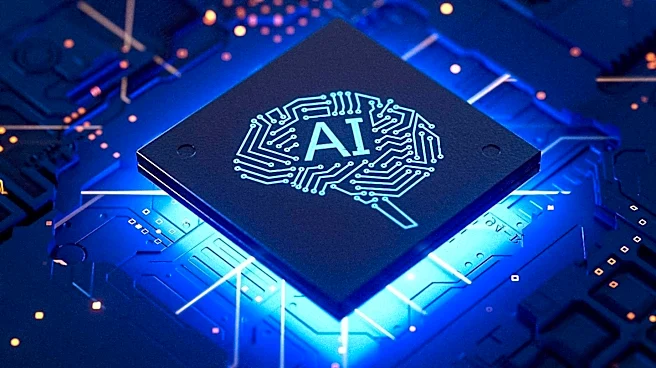
Cambricon Technologies, a Chinese semiconductor company specializing in AI chips, has reported substantial financial growth. For the first nine months of 2026, the company's revenue surged by 106.8% year-on-year, reaching RMB 9.526 billion (approximately
US$1.419 billion). Net profit attributable to shareholders also saw a significant increase of 131.5%, totaling RMB 3.715 billion (approximately US$553.43 million). This growth is attributed to expanding market presence and increased adoption of AI applications. Cambricon is actively involved in developing AI-computing workloads within China, competing with other major Chinese technology firms like Huawei and Alibaba Group. The company's strategy includes adapting its platform to major Chinese AI models, emphasizing that software compatibility is as crucial as raw chip speed for commercial deployment and customer satisfaction.
Why It's Important?
Cambricon's rapid growth highlights China's aggressive push to establish self-sufficiency and dominance in the global AI chip market. This development is critical for the U.S. as it signifies a potential shift in the global technology supply chain and could impact U.S. semiconductor companies. As China aims to increase its domestic AI-processor shipments, projected to rise nearly sixfold by 2030, the competition intensifies for U.S. firms that currently hold significant market share. The focus on complete computing systems, rather than just raw chip speed, by Chinese companies like Cambricon, Huawei, and Alibaba, suggests a comprehensive strategy to build robust AI ecosystems. This approach could create formidable competitors, potentially affecting U.S. companies' market access and technological leadership in AI hardware and software solutions.
What's Next?
Cambricon is expected to continue scaling its commercial deployments and further integrate its platforms with various Chinese AI models. The broader trend in China's semiconductor industry indicates a shift towards building comprehensive ecosystems around AI chips, including software platforms and large-scale computing infrastructure. This means future developments will likely focus on enhancing model compatibility and securing repeat customer deployments, rather than solely on chip specifications. U.S. policymakers and businesses will need to closely monitor these advancements, as China's progress in AI chip development and ecosystem building could lead to increased competition and potential challenges for U.S. technology exports and intellectual property. The emphasis on domestic alternatives also suggests a continued effort to reduce reliance on foreign technology.
Beyond the Headlines
The success of companies like Cambricon extends beyond mere financial figures; it represents a strategic national effort by China to reduce its dependence on foreign technology, particularly in critical areas like AI. This push has significant geopolitical implications, potentially leading to a more fragmented global technology landscape. The emphasis on building complete computing systems, including software and infrastructure, suggests a long-term vision to create self-sustaining technological ecosystems. This could lead to divergent technological standards and platforms, complicating international collaboration and market access for U.S. companies. Furthermore, the ethical and security implications of advanced AI capabilities developed independently by different nations will become increasingly prominent, influencing international relations and cybersecurity policies.