




What's Happening?
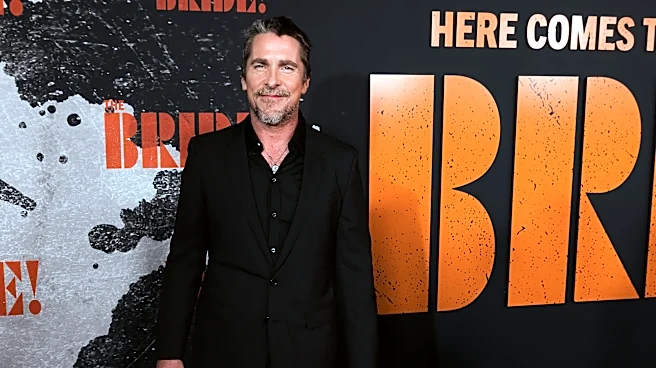
Christian Bale's recent filmography has become a subject of debate among film fans and critics due to a series of poorly reviewed releases. Known for his transformative and Oscar-winning performances, Bale has recently starred in several high-profile
projects that have not garnered critical acclaim. Notable examples include the David O. Russell-directed John Madden biopic, 'Madden,' which received a dismal 15% approval rating on Rotten Tomatoes, and earlier films like 'Amsterdam' (32% on Rotten Tomatoes) and 'Thor: Love and Thunder.' This pattern has led to discussions about whether Bale is experiencing a creative slump or intentionally choosing unconventional and unpredictable roles. Despite the films' reception, observers generally do not attribute the failures to Bale's acting talent or work ethic, suggesting instead that even a committed lead performance cannot salvage weak writing or muddled direction.
Why It's Important?
This trend in Christian Bale's career highlights a broader discussion within the film industry regarding the impact of star power versus script quality and direction. For actors with established critical acclaim and commercial success, the freedom to choose diverse roles can lead to experimental projects that may not always resonate with critics or audiences. This situation also underscores the challenges faced by even highly talented actors when working on films with perceived flaws in writing or direction. The debate reflects evolving audience expectations and the influence of review aggregators like Rotten Tomatoes on a film's perceived success. It also touches upon the fatigue some viewers express regarding formulaic biographical dramas, suggesting a potential shift in audience preferences for more original or less predictable cinematic content.
What's Next?
The ongoing debate surrounding Christian Bale's film choices suggests that future projects will likely be scrutinized with heightened attention, particularly regarding their critical reception. While some fans appreciate his willingness to take risks, others may hope for a return to more critically acclaimed roles. This situation could influence how studios approach casting for projects that are perceived as unconventional or potentially divisive, potentially leading to more cautious selections or a greater emphasis on script development. The discussion also hints at a continued trend where individual performances, even strong ones, may struggle to elevate a film if other fundamental elements are lacking, prompting a re-evaluation of what constitutes a 'successful' film in the eyes of both critics and the public.
Beyond the Headlines
Beyond the immediate critical reception, Christian Bale's recent film choices raise questions about the artistic freedom afforded to established actors and the evolving landscape of Hollywood. His ability to choose 'whatever he wants' after decades of success points to a privilege that allows for experimentation, even if it results in commercially or critically challenging films. This phenomenon can be seen as a form of artistic exploration, where the actor prioritizes unique experiences over guaranteed critical success. It also highlights the subjective nature of film appreciation, with some viewers finding 'absurd appeal' in watching powerhouse actors commit to 'messy material.' This perspective suggests a growing segment of the audience that values the actor's commitment and the film's entertainment value, even if it doesn't align with traditional critical metrics.