




What's Happening?
General Motors (GM) has commenced production of its next-generation 2027 Chevrolet Silverado 1500 and GMC Sierra 1500 pickup trucks. CEO Mary Barra confirmed this development during the company's third-quarter earnings call on October 20, stating that
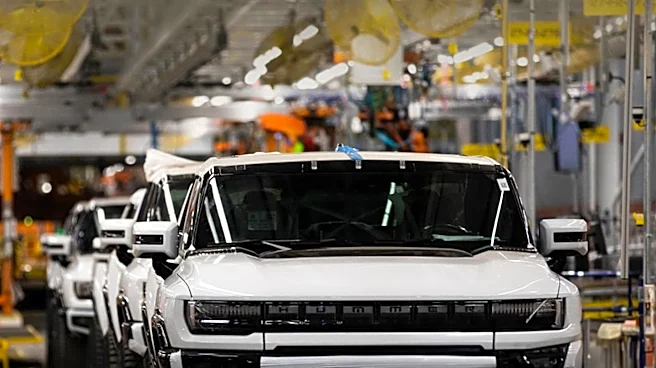
the first trucks are expected to reach dealerships later this year. The rollout will be a gradual process, involving three assembly plants and three engine plants, with a staggered changeover extending into 2027. Production began at GM's Silao plant in Mexico, which completed its changeover downtime and started building the new trucks in mid-October. The Fort Wayne, Indiana, plant will pause for four weeks in mid-December before restarting in January to build the new generation. Oshawa, Ontario, will cease Silverado 1500 production in November and will not produce the new model. Orion Assembly in Michigan is slated to join the production network in the second quarter of 2027.
Why It's Important?
The launch of the next-generation Silverado and Sierra trucks is critically important for General Motors and the broader U.S. automotive market. Full-size trucks are a significant profit engine for GM, with North America contributing $3.6 billion in adjusted EBIT and an 8.7% margin in the last quarter. GM's U.S. full-size pickup market share has grown by 10 points since the current generation's launch, underscoring the segment's importance. A successful and 'flawless launch,' as emphasized by CEO Mary Barra, is essential to maintain this profitability, which in turn funds other strategic initiatives, including software development and electric vehicle plans. Any stumble in this launch could have widespread financial repercussions for the company. For consumers, the staggered rollout means a split market, with outgoing models being sold alongside a slow introduction of the new trucks, starting with popular V8 Crew Cab configurations.
What's Next?
The production ramp-up for the 2027 Chevrolet Silverado and GMC Sierra will continue through 2027, with additional plants coming online. GM anticipates that 2027 output will be roughly flat compared to 2026 due to the changeover, with increased capacity expected in 2028. The company will focus on ensuring a smooth transition and maintaining quality as production scales. For buyers, this means a gradual increase in the availability of the new models, with V8-powered Crew Cab models arriving first, followed by Double Cab, Regular Cab, and lower trims. The aftermarket industry will also begin developing new parts and accessories for the 2027 models, a process that typically takes time. GM's strategy prioritizes quality over an immediate flood of inventory, aiming for a 'flawless launch' to protect its crucial truck segment.
Beyond the Headlines
The deliberate and staggered launch of GM's new trucks reflects a strategic shift in manufacturing and supply chain management within the automotive industry. This approach, prioritizing a 'flawless launch' over rapid volume, suggests lessons learned from past production challenges and a heightened focus on quality control in a complex global supply chain environment. The decision to discontinue Silverado production at the Oshawa plant while bringing Orion Assembly online in 2027 also indicates ongoing adjustments to GM's manufacturing footprint and labor strategies. Furthermore, the integration of advanced technologies like Super Cruise as standard or optional features on these new trucks signals a broader trend towards autonomous and semi-autonomous driving capabilities becoming mainstream, even in traditional vehicle segments, which could reshape driving experiences and safety standards in the coming years.