







What's Happening?
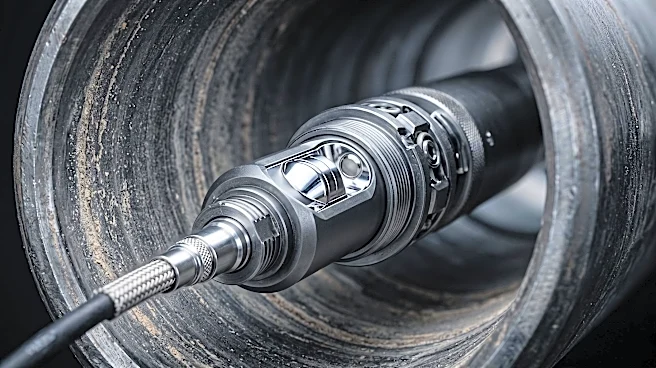
ARC Resources, a major natural gas producer, has partnered with acoustic imaging technology company DarkVision to develop a novel logging-while-perforating capability. This collaboration addresses the challenge of real-time tracking of casing deformation
in oil and gas wells, which previously caused operational uncertainty and inefficiencies in plug-and-perf (PnP) operations. The new system integrates DarkVision's acoustic imaging tool directly into the gun string, allowing for submillimetric resolution imaging of the casing interior during fracturing programs. This innovation enables operators to observe and quantify deformation as it occurs, providing critical data within hours to inform immediate operational decisions. The upgraded tool has undergone extensive testing and has been successfully deployed in over 20 runs without impacting perforation operations or tool integrity.
Why It's Important?
This technological advancement holds significant importance for the U.S. oil and gas industry, particularly in enhancing operational efficiency and safety. Casing deformation can lead to costly delays, skipped stages, and lost lateral in PnP operations. By providing real-time, high-resolution data, the new system allows companies to proactively manage and mitigate these issues, reducing non-productive time and associated expenses. The ability to track deformation stage-by-stage improves mill-out planning and sand delivery logistics, leading to more consistent treatment volumes and pressures. This innovation can translate into substantial cost savings and improved resource recovery for operators, making U.S. energy production more efficient and competitive.
What's Next?
ARC and DarkVision plan to continue building on the success of their field trials. Future work includes repositioning the imaging tool below the gun string to enable pre-frac perforation evaluation alongside deformation scanning in a single run. They are also optimizing setting tools for different plug types and sharing findings with manufacturers to improve plug selection. The broader industry is expected to adopt similar integrated diagnostic approaches, as the workflow model demonstrates the value of embedding instrumentation into existing operational toolstrings to collect high-value subsurface data at near-zero incremental cost. This could lead to a wider industry shift towards more data-driven, real-time decision-making in well completions.
Beyond the Headlines
The development signifies a deeper trend towards digitalization and advanced sensor integration within the energy sector. By transforming a previously ambiguous diagnostic process into a precise, real-time data stream, the collaboration highlights the increasing reliance on sophisticated technology to optimize complex industrial operations. This approach not only improves efficiency but also contributes to a more sustainable operational footprint by minimizing waste and maximizing resource utilization. The success of this project could inspire similar innovations in other challenging industrial environments where real-time monitoring and data-driven insights are crucial for performance and safety, pushing the boundaries of what is possible in remote and harsh operational settings.