



What's Happening?
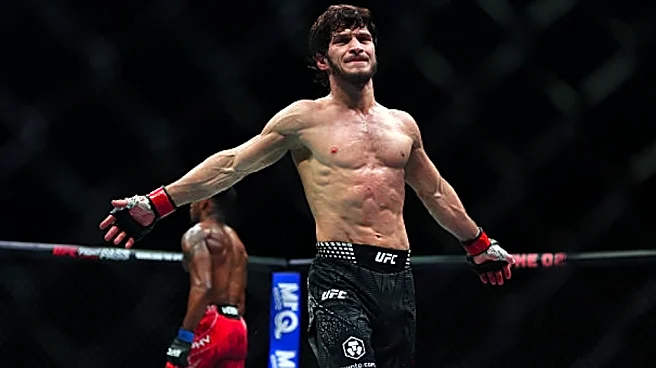
Movsar Evloev, an undefeated UFC featherweight contender, has suggested that the UFC should create a separate league specifically for women's mixed martial arts. In a recent interview, Evloev stated that he finds women's fights difficult to watch and
rarely does so. He cited the second fight between Joanna Jedrzejczyk and Rose Namajunas as the only high-level women's bout he has seen, implying that most others have not impressed him. These comments are likely to generate significant pushback within the MMA community, particularly in the United States, where female fighters like Ronda Rousey, Amanda Nunes, Weili Zhang, and Valentina Shevchenko have been instrumental in bringing women's MMA into the mainstream. The UFC has historically treated its women's divisions as a core part of its product, with female fighters headlining major events.
Why It's Important?
Evloev's remarks challenge the established integration and prominence of women's divisions within the UFC, a promotion that has actively championed female athletes. His suggestion for a separate league could be perceived as undermining the progress made in gender equality within combat sports. The UFC's commitment to its women's divisions has not only expanded its audience but also provided significant opportunities and platforms for female athletes, contributing to the sport's overall growth and diversity. A move towards segregation, as proposed, could diminish the visibility and perceived value of women's MMA, potentially impacting sponsorships, media coverage, and fighter compensation. This discussion highlights ongoing debates about gender roles and equity in professional sports, particularly in physically demanding disciplines like MMA.
What's Next?
The immediate consequence of Evloev's comments is likely to be widespread discussion and potential criticism from fans, fellow fighters, and media personalities within the MMA world. The UFC leadership, including President Dana White, may need to address these statements to reaffirm their commitment to women's MMA. Historically, the UFC has shown strong support for its female athletes, even considering a women's BMF title, which is a stark contrast to Evloev's proposal. While it is improbable that the UFC would adopt such a segregationist model, the controversy could influence public perception of Evloev as he pursues a featherweight title shot. His performance in upcoming fights will be scrutinized not only for his athletic prowess but also in the context of these controversial remarks.
Beyond the Headlines
Evloev's comments touch upon deeper societal perceptions of women in traditionally male-dominated sports. While he frames his opinion as a matter of fight quality, it implicitly raises questions about the acceptance and valuation of female athleticism. The success of women's MMA in the UFC has been a significant cultural shift, demonstrating that female athletes can draw large audiences and deliver compelling performances. Any suggestion of separating leagues, even if not acted upon, can reignite discussions about inherent biases and the challenges women face in achieving equal recognition and opportunities in professional sports. This incident serves as a reminder that despite advancements, the journey towards full gender equity in sports is ongoing and subject to periodic challenges.