
What's Happening?
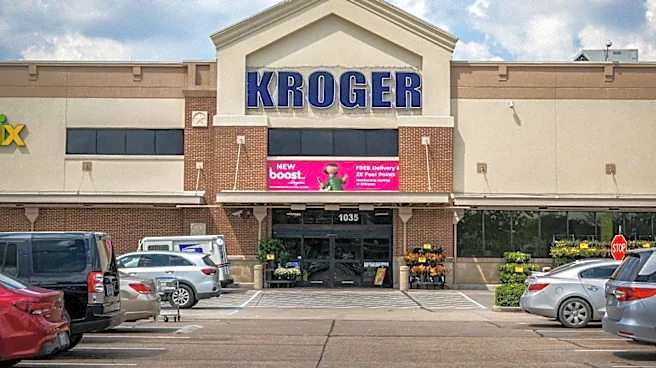
CX Institutional has significantly decreased its holdings in The Kroger Co. (NYSE:KR) by 43.3% during the third quarter, selling 18,417 shares and reducing its total ownership to 24,133 shares, valued
at approximately $1,415,000. This move comes as several equities analysts have adjusted their price targets and ratings for Kroger. Wells Fargo & Company set a $58.00 target price, Morgan Stanley cut its target from $73.00 to $67.00 with an 'equal weight' rating, and Wall Street Zen downgraded Kroger from a 'buy' to a 'hold' rating. Guggenheim reaffirmed a 'buy' rating but lowered its target price from $71.00 to $66.00, while JPMorgan Chase & Co. reduced its target from $72.00 to $70.00, maintaining a 'neutral' rating. Despite these adjustments, Kroger's stock opened at $58.99, with a market capitalization of $34.84 billion.
Why It's Important?
The reduction in institutional ownership by CX Institutional, coupled with revised price targets and ratings from multiple prominent financial analysts, signals a shifting sentiment towards Kroger's stock performance. While some analysts maintain a 'buy' rating, the overall trend of lowered price targets and downgrades to 'hold' or 'neutral' suggests a more cautious outlook on the company's near-term growth prospects. This could influence other institutional investors and individual shareholders, potentially leading to further stock price volatility. The company's financial health, including its 50-day moving average price of $58.22 and a 200-day moving average price of $62.51, indicates a recent downward trend. The analyst adjustments reflect concerns about Kroger's fiscal 2026 identical-sales outlook and rising operating costs, which could impact its profitability and market valuation.
What's Next?
Kroger recently reported its quarterly earnings, with $1.09 earnings per share, surpassing analysts' consensus estimates of $1.05. The company's revenue for the quarter was $34.62 billion, a 2.0% increase year-over-year. Kroger has set its FY 2026 guidance at 5.100-5.300 EPS, with analysts expecting 5.19 earnings per share for the current year. The company also declared a quarterly dividend of $0.39 per share, payable on December 1st, with an ex-dividend date of November 16th. This represents an annualized dividend of $1.56 and a dividend yield of 2.6%. The company's ongoing initiatives, such as testing 24-hour operations in some Ohio and Indiana stores, investing in store renovations, and growing e-commerce sales, aim to improve customer experience and drive sales. However, the impact of these efforts will be closely watched against the backdrop of analyst concerns regarding sales outlook and operating costs.
Beyond the Headlines
The analyst revisions and institutional stake reduction highlight the broader challenges faced by large retail chains like Kroger in a dynamic market. The company's efforts to innovate with 24-hour operations and enhanced e-commerce capabilities reflect a strategic response to evolving consumer demands and competitive pressures. However, the 'negative sentiment' regarding protests over the higher cost of cage-free eggs underscores the delicate balance between consumer preferences, ethical sourcing, and pricing strategies. This situation could trigger a re-evaluation of how retailers manage supply chain costs and communicate pricing changes to avoid alienating price-sensitive customers. The long-term success of Kroger will depend on its ability to navigate these complex factors, maintain profitability, and adapt to changing market conditions while addressing investor concerns about its growth trajectory and operational efficiency.