






What's Happening?
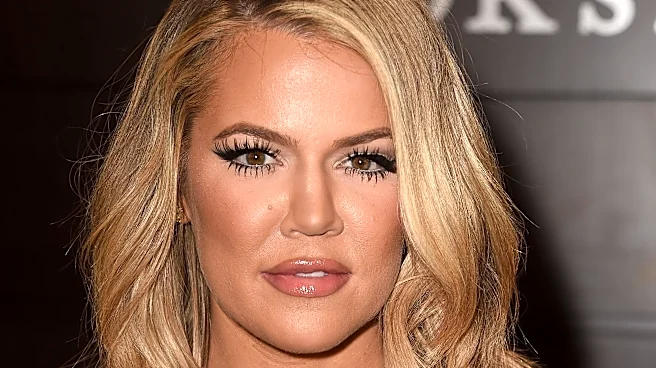
Khloé Kardashian recently shared a parenting anecdote on her podcast, 'Khloé in Wonder Land,' featuring actor Goldie Hawn. Kardashian recounted how she prevented her eight-year-old daughter, True Thompson, from quitting gymnastics. True was reportedly
frustrated and comparing herself to her cousins because she struggled with a cartwheel. To address this, Kardashian intentionally attempted a cartwheel herself, fully expecting to fail, to show True that adults also struggle and that imperfection is normal. Kardashian's 'silly' and 'ridiculous' attempt ultimately boosted True's confidence, leading her to continue gymnastics for another three years. Kardashian emphasized the importance of children seeing adults 'trip or fail a little bit' and observing how they handle such situations, rather than presenting a facade of perfection.
Why It's Important?
Khloé Kardashian's parenting approach offers valuable insights into fostering resilience and self-acceptance in children, a critical aspect of child development in the U.S. and globally. Her method of demonstrating vulnerability and imperfection directly counters the societal pressure, often amplified by social media, for both children and adults to appear flawless. This approach can help children develop a healthier self-image, reduce anxiety related to performance, and encourage perseverance in the face of challenges. For parents, it highlights an alternative to traditional motivational tactics, suggesting that leading by example through shared struggle can be more effective than simply offering verbal encouragement. This perspective is particularly relevant in an era where children are increasingly exposed to curated, often unrealistic, portrayals of success.
What's Next?
Kardashian's public sharing of her parenting philosophy may encourage other parents to adopt similar strategies, promoting a more open and realistic approach to child-rearing. Discussions around the importance of vulnerability and imperfection in parenting are likely to continue gaining traction, potentially influencing educational programs and parenting resources. Furthermore, Kardashian also touched upon her decision to keep True, at eight years old, off social media and without a phone, a stance that aligns with growing concerns among parents and experts about the impact of early social media exposure on children's well-being. This could contribute to broader conversations about age-appropriate technology use and digital literacy for younger generations.
Beyond the Headlines
The narrative extends beyond individual parenting tips to address broader societal issues concerning perfectionism and the impact of digital culture on self-esteem. In a world saturated with idealized images and narratives, particularly on social media, children often face immense pressure to achieve and conform. Kardashian's story subtly critiques this culture by advocating for authenticity and the acceptance of human fallibility. This approach can contribute to a more compassionate and realistic understanding of personal growth, where mistakes are viewed as learning opportunities rather than failures. It also implicitly raises questions about the role of celebrity parents in shaping public discourse on child development and the challenges of raising children in the digital age.