






What's Happening?
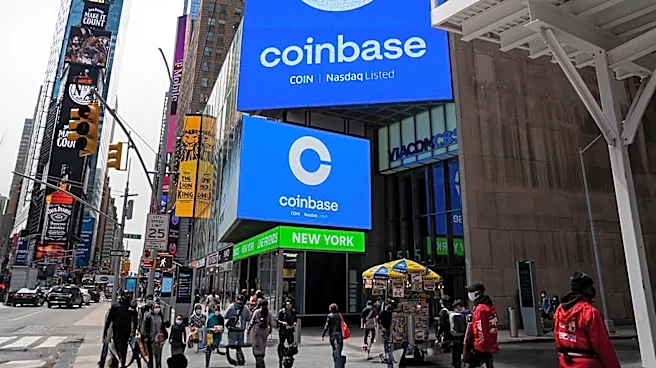
Following a record $6.3 billion hack of Binance, major cryptocurrency exchanges Coinbase and Kraken have intensified their security protocols. Coinbase CEO Brian Armstrong publicly offered assistance to Binance, stating his team was "blocking sends to compromised
wallets" and had contacted Binance to provide help. Coinbase also adjusted its offline cryptocurrency key storage systems as a precautionary measure. Kraken announced it is actively monitoring industry incidents to identify and apply lessons to its own defense mechanisms. The incident prompted calls for enhanced industry collaboration and real-time information sharing. OKX CEO Star Xu advocated for a system that would allow participants to share hack information instantly, coordinate responses, and temporarily freeze suspected stolen funds. Stablecoin issuers Tether and Circle have already frozen significant amounts linked to Binance, totaling nearly $1.57 billion and $800 million, respectively.
Why It's Important?
This incident underscores the persistent vulnerability of the cryptocurrency industry to sophisticated cyberattacks, even as it becomes more integrated into mainstream finance. The proactive measures taken by Coinbase and Kraken are crucial for maintaining user trust and demonstrating the industry's commitment to security. A major hack like Binance's can erode confidence among institutional investors and individual users, potentially hindering broader adoption of digital assets in the U.S. The call for greater industry collaboration and real-time alert systems highlights a recognized need for a unified front against cyber threats, which could lead to more robust security standards and protocols across the sector. The freezing of funds by stablecoin issuers demonstrates a critical mechanism for mitigating losses and recovering stolen assets, reinforcing the importance of such capabilities in the crypto ecosystem.
What's Next?
The cryptocurrency industry is likely to see a push for more standardized and collaborative security frameworks. Expect increased dialogue among major exchanges, security firms, and regulatory bodies to establish protocols for rapid information sharing and coordinated responses to hacks. This could lead to the development of industry-wide alert systems and shared threat intelligence platforms. Exchanges may also invest more heavily in advanced cybersecurity technologies and auditing processes to prevent future breaches. Regulators in the U.S. and globally might intensify their scrutiny of crypto exchange security practices, potentially leading to new compliance requirements. The incident could also accelerate the adoption of decentralized security solutions and multi-party computation techniques to reduce single points of failure. The focus will be on building a more resilient and secure infrastructure to protect user assets and foster continued growth in the digital asset space.
Beyond the Headlines
The Binance hack and subsequent industry response highlight a broader tension between the decentralized ethos of cryptocurrency and the need for centralized security measures. While blockchain technology offers inherent security advantages, the centralized nature of exchanges creates attractive targets for attackers. This incident could spark a deeper debate about the optimal balance between decentralization and security in the crypto ecosystem. It also brings to the forefront the geopolitical dimension of cybercrime, with analysts attributing the Binance hack to North Korea, underscoring the role of state-sponsored actors in targeting financial systems. The long-term implications could include a shift towards more self-custody solutions or the development of hybrid models that combine the benefits of centralized exchanges with enhanced decentralized security features. Ultimately, the industry's ability to adapt and innovate in response to such threats will be critical for its long-term viability and mainstream acceptance.