



What's Happening?
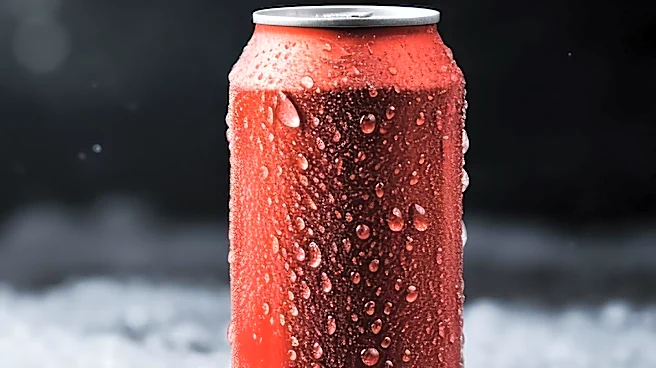
The common practice of tapping a soda can to prevent it from fizzing over when opened is largely ineffective, according to scientific explanations and experimental studies. Carbonated drinks contain dissolved carbon dioxide under high pressure and cold
temperatures, creating a supersaturated state. Shaking or dropping a can can cause tiny bubbles to form at nucleation sites, such as imperfections on the can's interior or dust particles. While the theory behind tapping suggests it might dislodge these bubbles, allowing them to rise into the air pocket before opening, experts like Roberto Zenit, a professor of engineering at Brown University, note that tapping too hard or repeatedly can actually create more bubbles. A 2019 preprint study involving 1,031 cans of beer found no statistically significant difference in liquid loss between tapped and untapped cans, regardless of whether they were shaken, indicating that tapping does not prevent spillage.
Why It's Important?
This information is important for consumers as it debunks a widely held belief and common practice. Understanding the physics behind carbonated beverages can help individuals avoid unnecessary actions and adopt more effective methods to prevent spills. For industries producing carbonated drinks, this research reinforces the importance of packaging integrity and temperature control in managing product stability. The study highlights how anecdotal solutions, even those with some theoretical basis, may not hold up under empirical scrutiny. It also underscores the value of scientific inquiry in everyday phenomena, providing evidence-based advice that can save consumers from sticky situations and wasted product.
What's Next?
Given that tapping is largely ineffective, consumers are advised to use alternative methods to prevent fizz over. Experts suggest letting a shaken can sit upright for several minutes to allow bubbles to dissolve or rise into the air pocket. Keeping the drink cold is also beneficial, as carbon dioxide remains dissolved more easily at lower temperatures. If immediate opening is necessary, slowly opening the can to allow gas to escape gradually can minimize spillage. This approach creates a small slit for foam to fizz out, and once the gas stops escaping, the can can be safely opened completely. These practical tips offer more reliable solutions for managing carbonated beverages.
Beyond the Headlines
The persistence of the 'tapping a soda can' myth illustrates how folk science and anecdotal evidence can become ingrained in popular culture, even without strong scientific backing. This phenomenon is common across various aspects of daily life, where intuitive explanations often override empirical data. The study serves as a reminder of the importance of critical thinking and evidence-based reasoning in evaluating common practices. It also touches upon the subtle complexities of fluid dynamics and gas solubility, demonstrating that seemingly simple everyday occurrences are governed by intricate physical principles. This kind of research contributes to a broader scientific literacy, encouraging a more informed approach to understanding the world around us.