





What's Happening?
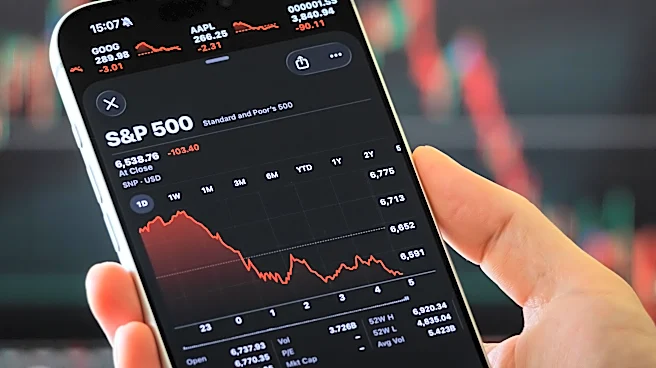
Michael Hartnett, Chief Investment Strategist at Bank of America, has indicated that a significant decline in U.S. equities, specifically the S&P 500 erasing its annual gains, could compel the Federal Reserve to halt its interest rate hikes. According
to Hartnett, this scenario would involve the S&P 500 falling to approximately 6,845, which is about 80 points or 1.2% below its recent closing level of 6,925. He identifies two critical thresholds for a potential policy shift: the S&P falling below 6,845 and the investment-grade CDX rising above 80 basis points. Hartnett suggests that if the Federal Reserve remains responsive to Wall Street pressures, a downturn in equities and widening credit spreads could accelerate the end of the rate-hiking cycle. Conversely, a more determined stance by the Federal Reserve against inflation could increase the risk of a hard landing for the economy.
Why It's Important?
This analysis from a prominent investment strategist highlights the intricate relationship between equity market performance and Federal Reserve monetary policy. A significant drop in the S&P 500 could signal economic distress, potentially influencing the Federal Reserve to reconsider its aggressive stance on interest rate hikes to prevent a deeper recession. This perspective is crucial for investors, businesses, and policymakers as it outlines a potential trigger for a shift in economic strategy. The implications extend to various sectors, including cyclical assets like cryptocurrencies, semiconductors, and real estate, which Hartnett suggests would become buying opportunities if the market narrative shifts from rate hikes to rate cuts. The potential for a 'hard landing' versus a 'soft landing' scenario, heavily influenced by the Federal Reserve's actions, carries substantial economic consequences for employment, inflation, and overall market stability.
What's Next?
Hartnett believes the market has not yet fully unwound its positions, despite recent price movements. He notes that the Bank of America’s November Fund Manager Survey indicates a low expectation for a hard landing, with only 3% of respondents anticipating it, while 50% expect a soft landing and 42% foresee no landing. Cash allocations are currently low at 3.6%, and stock funds and ETFs have seen record inflows of $310 billion over the past four weeks. Hartnett suggests that a full buy signal should not be issued until positions are unwound. He also warns that the probability of a hard landing might be underestimated, citing initial jobless claims exceeding 250,000 and investment-grade credit spreads widening beyond 100 basis points as key indicators. The Federal Reserve's response to these market signals will determine whether rate hikes continue or pause, potentially influencing market sentiment and investment strategies in the coming months.
Beyond the Headlines
The strategist's comparison to the 2000 tech stock cycle offers a deeper insight into market dynamics, reminding investors that even if the Federal Reserve stops raising rates, a bear market may not end immediately. During the 2000 cycle, the bear market persisted for two more years after the last rate hike due to earnings issues, with the Nasdaq experiencing multiple significant rebounds during its decline. This historical context suggests that a pause in rate hikes does not guarantee an immediate market recovery and that underlying economic fundamentals, such as corporate earnings, play a critical role. The current situation also raises questions about the Federal Reserve's independence and its susceptibility to Wall Street pressures, highlighting the ongoing tension between controlling inflation and supporting market stability. The interplay between market sentiment, economic indicators, and central bank policy will continue to shape the financial landscape.