




What's Happening?
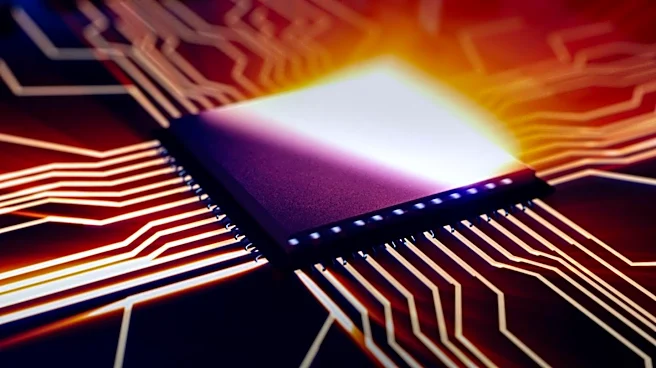
Texas Instruments (TI) is showcasing the sophisticated technology embedded in everyday devices, specifically its standalone USB Power Delivery controller. This chip is responsible for detecting cable connections, communicating over the connector's configuration
channel, negotiating power levels, and enabling the appropriate electrical path for charging. The complexity of this controller is compared to the Apollo Guidance Computer (AGC) used in the Apollo 11 mission. While the AGC had approximately 4 kilobytes of working memory and a 1 MHz processor, modern USB-C chargers, like those utilizing Infineon’s EZ-PD CCG3PA controller, can feature 32-bit Arm Cortex-M0 processors, 64 KB of flash, 8 KB of SRAM, and CPU clocks up to 48 MHz. This illustrates a significant leap in computational capability and memory in seemingly simple electronic components, far surpassing the raw numerical specifications of the Apollo 11 computer.
Why It's Important?
The advancement in embedded systems, as demonstrated by Texas Instruments' USB Power Delivery controller, is crucial for the ongoing evolution of consumer electronics and various industries. The ability of these small, specialized computers to manage complex tasks like power negotiation and fault detection ensures the safety, efficiency, and interoperability of countless devices. This technological progress allows for faster charging, more reliable power delivery, and the development of new functionalities in portable electronics. For the U.S. technology sector, this signifies continued innovation and leadership in semiconductor design and manufacturing, driving economic growth and maintaining a competitive edge in the global market. The comparison with the Apollo Guidance Computer also highlights how engineering priorities have shifted from raw computational power for specific, critical tasks to ubiquitous, highly efficient, and versatile embedded intelligence in mass-produced goods.
What's Next?
The trend towards more powerful and efficient embedded systems is expected to continue, with companies like Texas Instruments investing in research and development to integrate even more advanced features into smaller, more energy-efficient packages. Future developments may include enhanced security protocols within power delivery systems, more intelligent power management for diverse device ecosystems, and further integration with emerging technologies such as the Internet of Things (IoT). As devices become more interconnected and reliant on seamless power delivery, the sophistication of these controllers will be paramount. This ongoing innovation will likely lead to new industry standards, improved user experiences, and potentially new applications for embedded computing beyond traditional charging functions, impacting sectors from automotive to industrial automation.
Beyond the Headlines
The evolution of embedded systems, exemplified by Texas Instruments' USB Power Delivery controller, underscores a fundamental shift in technological design philosophy. The Apollo Guidance Computer was a marvel of its time, meticulously engineered for a singular, life-critical mission where predictability and reliability were paramount, even with limited resources. Today's embedded systems, while less glamorous, embody a different kind of engineering triumph: making complex computational power accessible, affordable, and robust enough for everyday use in billions of devices. This pervasive integration of 'tiny, specialized computers' raises questions about digital literacy, the hidden complexity of modern life, and the increasing reliance on sophisticated algorithms for even basic functions. It also highlights the ethical considerations of ensuring the security and privacy of data flowing through these increasingly intelligent, interconnected devices, even those as seemingly innocuous as a USB charger.