

What's Happening?
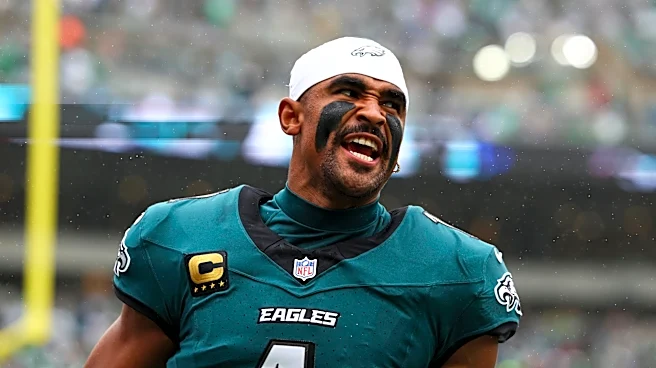
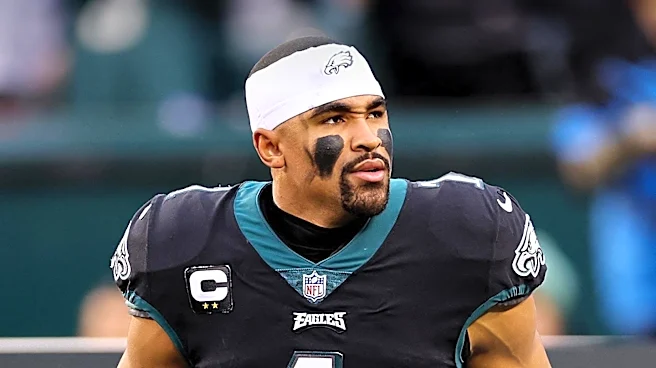
Former All-Pro wide receiver Terrell Owens has asserted that the Philadelphia Eagles' potential for success is directly tied to quarterback Jalen Hurts. Owens, in an interview with RotoGrinders, stated that the Eagles will only be as successful as Hurts allows
them to be, positioning the quarterback as the central figure of the team. While acknowledging the Eagles' talented defense, Owens emphasized that the defense serves as a supporting cast, and the ultimate trajectory of the team rests on Hurts' ability to deliver results. He also ranked Hurts as a top-two or top-three quarterback, arguing that excluding him from the top five overlooks his significant accomplishments in a relatively short career.
Why It's Important?
This assessment by Terrell Owens is important for the Philadelphia Eagles and their fans as it highlights the critical role of a franchise quarterback in modern NFL success. It underscores the immense pressure and responsibility placed on a single player to elevate an entire team, even one with a strong supporting defense. For the broader sports landscape, it reinforces the narrative that quarterback play is often the most significant determinant of a team's championship aspirations. Owens's comments could influence public perception, media narratives, and even future strategic decisions for the Eagles, particularly concerning their long-term commitment to Hurts and roster construction around him. It also sparks debate among analysts and fans about the true value and ranking of top NFL quarterbacks.
What's Next?
Following Terrell Owens's strong statements, the focus on Jalen Hurts's performance will likely intensify throughout the upcoming season. Every game will be scrutinized through the lens of whether Hurts is indeed living up to the high expectations set by Owens. The Eagles' coaching staff and front office will continue to build around Hurts, aiming to provide him with the necessary tools and support to maximize his potential. Fans and media will closely monitor his statistics, leadership, and ability to win crucial games, especially as the team progresses into the playoffs. The team's overall success will be seen as a direct reflection of Hurts's capabilities, potentially shaping his legacy and the team's future direction.
Beyond the Headlines
Terrell Owens's commentary delves into the deeper psychological and strategic aspects of team sports. By emphasizing Hurts's role, Owens touches upon the concept of a 'franchise player' and the disproportionate impact one individual can have on collective success. This goes beyond mere statistics, hinting at leadership, resilience, and the ability to perform under pressure, even when traditional metrics might not be flashy. It also raises questions about the balance between individual talent and team synergy, and how much a strong supporting cast can truly compensate for perceived deficiencies in a star player. Owens's perspective, coming from a Hall of Fame player, adds weight to the ongoing discussion about what truly defines greatness and success in professional sports.