





What's Happening?
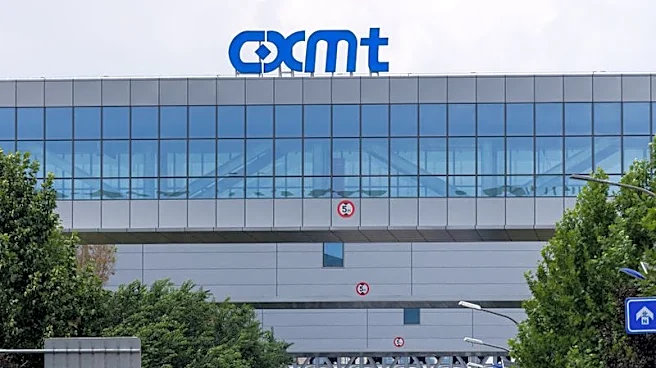
ChangXin Memory Technologies (CXMT), China's largest DRAM manufacturer, has announced that its fifth-generation technology platform has entered mass production. Luo Xiaodong, vice president of CXMT, stated that the company's process capability is now
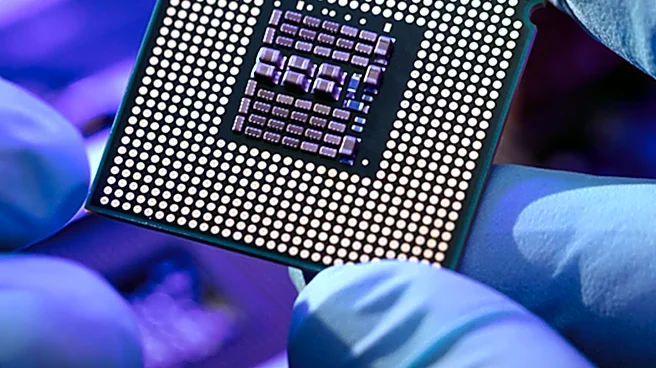
on par with the most advanced mass-produced nodes in the industry. The new platform features an active area half-pitch of 11.95 nanometers and a storage capacitor aspect ratio of 45 to 1, achieved using four-exposure patterning. This technology yields at least 50% more dies per wafer than its fourth generation. Two 24-gigabit LPDDR5X products, designed for smartphones and portable electronics, are already running on this platform, offering 50% more data capacity than previous CXMT chips.
Why It's Important?
CXMT's claim of achieving parity with global leaders in DRAM production has significant implications for the U.S. technology sector and its supply chain resilience. Currently, U.S. electronics makers primarily rely on a few non-Chinese suppliers for DRAM. CXMT's emergence as a competitive alternative could diversify the global memory supply, potentially easing future shortages and offering more choices to U.S. companies. This development is particularly relevant given U.S. export controls that have restricted China's access to advanced chipmaking equipment. CXMT's ability to develop this platform using workarounds like four-exposure patterning demonstrates a growing self-sufficiency in China's semiconductor industry, which could alter global market dynamics and influence U.S. strategic planning regarding technology independence and supply chain security.
What's Next?
The immediate next step for CXMT is to secure broader adoption of its fifth-generation DRAM products by electronics manufacturers, both within China and internationally. While Chinese handset makers have an obvious incentive, the key will be whether Western brands, beyond early adopters like Corsair, integrate CXMT memory at scale. The market will closely watch for data on yield rates and pricing, as these factors will determine the true competitiveness of CXMT's offerings. The broader question involves how governments outside China will react to this new source of memory. The U.S. government, in particular, will likely monitor the implications for national security and economic competitiveness, potentially influencing trade policies and investment decisions related to the semiconductor industry.
Beyond the Headlines
CXMT's announcement goes beyond a simple product launch; it represents a significant geopolitical and technological statement. The company's emphasis on 'resilience' in the supply chain directly addresses the impact of U.S. export controls, signaling China's determination to reduce its reliance on foreign technology. The use of four-exposure patterning, a workaround for restricted advanced equipment, highlights the ingenuity and resourcefulness being deployed in the face of technological barriers. This development could accelerate a decoupling of technology supply chains, forcing U.S. companies to re-evaluate their sourcing strategies and potentially invest more in domestic production or diversify suppliers to mitigate risks. The long-term implications include a more fragmented global semiconductor market and intensified competition, with potential impacts on innovation, pricing, and the overall technological landscape.