








What's Happening?
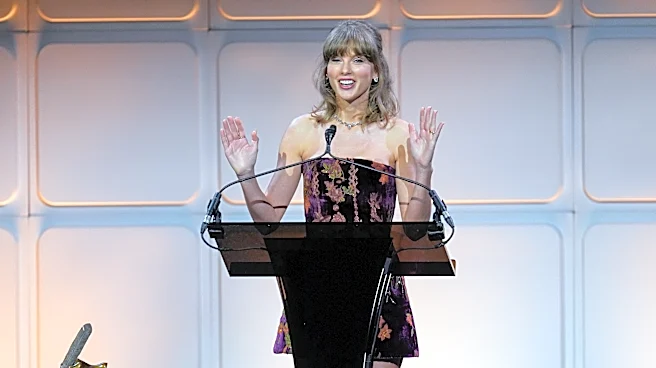
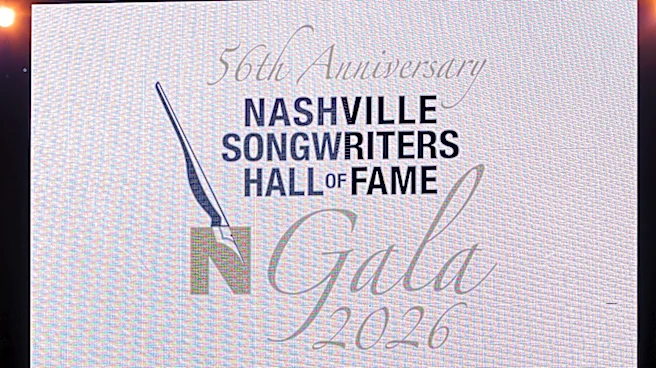
Taylor Swift has been inducted into the Nashville Songwriters Hall of Fame, becoming the youngest artist to receive this honor. The 14-time Grammy winner, aged 36, expressed her gratitude at the Music City Center in Nashville, acknowledging the profound
influence of the city's music industry on her songwriting. Swift highlighted that songwriters possess a 'superhuman ability to understand and interpret the human condition' and have guided her through her formative years. She emphasized that her ability to 'genre-hop and travel the world' and collaborate with diverse individuals stems from the foundational knowledge gained in Nashville. Swift, who moved to Nashville with her family at age 11, credited the city for honing and polishing her passion for songwriting. Other inductees this year include Lyle Lovett, Shawn Camp, Bruce Channel, and Lee Thomas Miller.
Why It's Important?
This induction is significant as it formally recognizes Taylor Swift's profound impact and enduring legacy as a songwriter within the U.S. music industry at a remarkably young age. Her acknowledgment by the Nashville Songwriters Hall of Fame underscores the critical role of songwriting in her career, distinguishing her not just as a performer but as a master lyricist and composer. This honor can inspire a new generation of aspiring songwriters, particularly those who may feel constrained by genre boundaries, given Swift's successful 'genre-hopping.' For Nashville, it reinforces its status as a pivotal hub for musical talent and songwriting development, attracting and nurturing artists who go on to achieve global recognition. The inclusion of a pop superstar like Swift in a traditionally country-music-oriented institution also highlights the evolving and increasingly interconnected nature of different music genres in the U.S.
What's Next?
Following this induction, Taylor Swift's status as a revered songwriter is further solidified, potentially leading to increased critical analysis and academic study of her lyrical contributions. This recognition may also influence future award considerations, placing greater emphasis on her songwriting prowess in addition to her performance and commercial success. For the Nashville Songwriters Hall of Fame, Swift's induction could bring broader public attention to the organization and its mission of preserving songwriting legacies, potentially attracting more diverse artists and audiences. Her continued success and influence are likely to encourage more artists to consider Nashville as a starting point for their careers, further cementing the city's role in shaping the future of American music. Swift's ongoing projects, including potential new music or re-recordings, will likely be viewed through the lens of her now officially recognized songwriting mastery.
Beyond the Headlines
Beyond the immediate recognition, Swift's induction into the Nashville Songwriters Hall of Fame carries deeper cultural implications. It challenges traditional perceptions of what constitutes a 'hall of fame' artist, particularly in a genre-specific context, by honoring a figure who has transcended multiple musical categories. This event also highlights the often-underestimated craft of songwriting, bringing it to the forefront of public discourse and emphasizing its foundational role in popular music. For aspiring artists, it serves as a powerful testament to the value of authentic storytelling and lyrical depth in achieving lasting success. Furthermore, Swift's journey from an 11-year-old aspiring artist in Nashville to a Hall of Fame inductee at 36 exemplifies the American dream narrative of talent, perseverance, and the pursuit of artistic excellence, resonating with a wide audience beyond the music industry.