






What's Happening?
Advanced Micro Devices (AMD) reported its third-quarter earnings, surpassing both revenue and earnings per share (EPS) expectations. The company announced an EPS of $2.09 on revenue of $13.38 billion, exceeding analyst projections of $1.97 EPS on $13.08
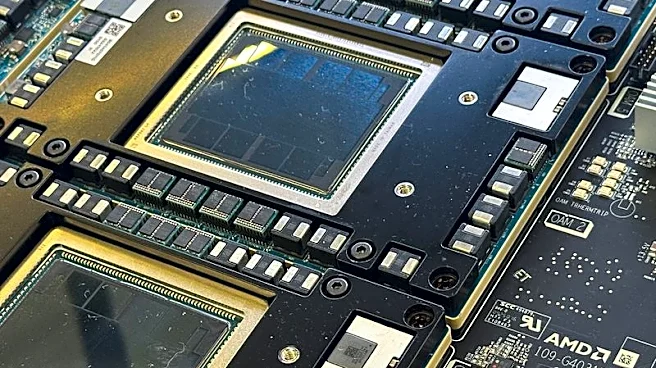
billion in revenue. A significant driver of this performance was the data center segment, which saw a 97% increase in revenue, reaching $8.5 billion, well above the estimated $8.19 billion. CEO Lisa Su attributed this growth to strong demand for Instinct and EPYC products, anticipating further acceleration in the fourth quarter with the scaling of Helios and 'Venice' production. Following the announcement, AMD's stock climbed more than 7%.
Why It's Important?
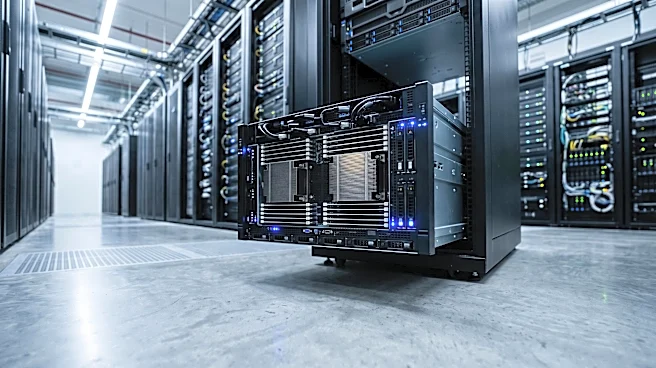
AMD's robust third-quarter performance, particularly the near-doubling of its data center revenue, highlights the escalating demand for high-performance computing and artificial intelligence infrastructure in the U.S. and globally. This growth signals a strong market position for AMD in a critical and rapidly expanding sector, contrasting with some competitors who have faced challenges. The company's success in data centers is vital for various U.S. industries, including cloud computing, enterprise technology, and AI development, as it provides the foundational hardware necessary for these advancements. The positive stock reaction reflects investor confidence in AMD's strategic direction and its ability to capitalize on the AI boom, potentially influencing broader market sentiment towards technology stocks.
What's Next?
AMD anticipates continued growth, with CEO Lisa Su expecting an acceleration in the fourth quarter as Helios and 'Venice' production scales. The company's focus on its leadership product portfolio and strong customer and supply chain relationships suggests a sustained trajectory of revenue growth and expanding profitability. Investors will closely monitor AMD's ability to meet this accelerated demand and manage its supply chain effectively. The company's performance will also be a key indicator for the broader semiconductor industry, influencing investment in AI-related hardware and potentially impacting the competitive landscape with rivals like Intel. Future earnings calls will likely provide more details on the progress of these initiatives and their impact on financial results.
Beyond the Headlines
AMD's impressive data center growth underscores a significant shift in the technology landscape, where AI and cloud computing are becoming central to economic activity. This trend has broader implications for U.S. technological leadership and innovation. The increasing reliance on advanced processors for AI workloads means that companies like AMD are not just selling chips but are enabling the next generation of technological breakthroughs across various sectors, from healthcare to finance. The competition in this space also drives continuous innovation, pushing the boundaries of computing power and efficiency. Furthermore, the substantial capital expenditures required to support this growth highlight the massive investments being made in digital infrastructure, which will have long-term effects on employment, economic output, and national competitiveness.