




What's Happening?
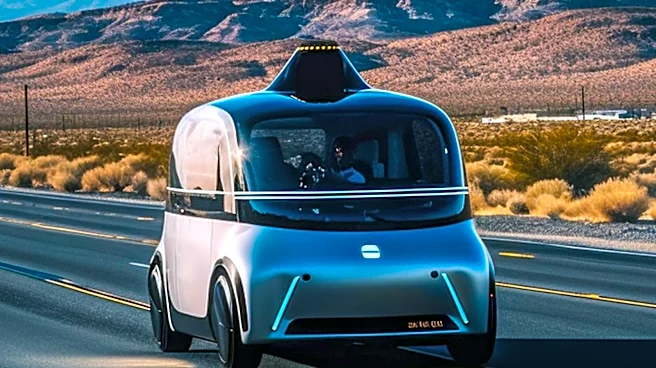
Amazon-owned Zoox has initiated paid robotaxi services at Harry Reid International Airport in Las Vegas, becoming the first fully driverless company to operate at the facility. The service, which began on September 3, offers pickups at both Terminal 1
and Terminal 3, strategically located closer to baggage claim areas than traditional rideshare services like Uber and Lyft. According to Casino.org, this launch follows a year-long public testing phase where Zoox provided free rides, transitioning to paid service on August 10. Ron Thaniel, Zoox's senior director of policy and regulatory affairs, acknowledged the support from the Clark County Department of Aviation and the state of Nevada in making this airport expansion possible. The Zoox vehicles connect the airport to ten Strip resorts, including Mandalay Bay, Luxor, MGM Grand, and Bellagio, and also serve other key locations such as Area15, the Las Vegas Convention Center, and the Sphere. Fares for early users ranged from approximately $23 to $26, varying with demand and time of day.
Why It's Important?
The introduction of Zoox's driverless robotaxi service at Harry Reid International Airport marks a significant advancement in autonomous vehicle technology and its integration into public transportation infrastructure in the U.S. This development enhances convenience for travelers by offering pickups closer to baggage claim, potentially reducing the walking distance often associated with other rideshare options. For the Las Vegas tourism and hospitality industry, this service provides an innovative transportation solution, catering to visitors arriving at the airport and connecting them directly to major resorts and attractions. The move also intensifies competition within the burgeoning robotaxi market, as Nevada's Transportation Authority has issued commercial robotaxi permits to other major players like Tesla, Waymo, and Uber, indicating a future with up to 8,000 autonomous vehicles operating in Clark County. This expansion could set a precedent for other U.S. airports and cities considering autonomous vehicle integration, influencing urban planning and transportation policies.
What's Next?
The Las Vegas robotaxi market is poised for significant growth and increased competition. With commercial permits issued to Tesla, Waymo, and Uber, the region could see up to 8,000 autonomous vehicles operating within the next year, according to Casino.org. This influx of services will likely lead to more widespread adoption of robotaxis and potentially more competitive pricing. Zoox will need to address current limitations, such as the lack of dedicated luggage compartments and the app's restriction to the American App Store, to better serve a broader range of travelers, particularly international visitors and groups with multiple large bags. The expansion of service to include more hotels, especially off-Strip and downtown Las Vegas destinations, will also be a crucial next step for Zoox to capture a larger market share. The success and challenges faced by Zoox in Las Vegas will likely inform regulatory frameworks and operational strategies for autonomous vehicle deployment in other major U.S. cities and airports.
Beyond the Headlines
The deployment of Zoox's driverless robotaxis at a major U.S. airport raises broader implications concerning the future of urban mobility, labor markets, and technological accessibility. The convenience offered by direct airport pickups could reshape traveler expectations for ground transportation, pushing traditional rideshare and taxi services to innovate. However, the current limitations, such as luggage capacity and app accessibility for international users, highlight the ongoing challenges in making autonomous services universally inclusive. Ethically, the increasing reliance on AI-driven transportation systems necessitates robust discussions around safety protocols, liability in case of accidents, and data privacy. Furthermore, the rise of robotaxis could have long-term effects on employment in the transportation sector, prompting a need for workforce retraining and new economic models. This technological shift in Las Vegas serves as a real-world case study for how autonomous vehicles can integrate into complex urban environments and the societal adjustments that accompany such innovations.