





What's Happening?
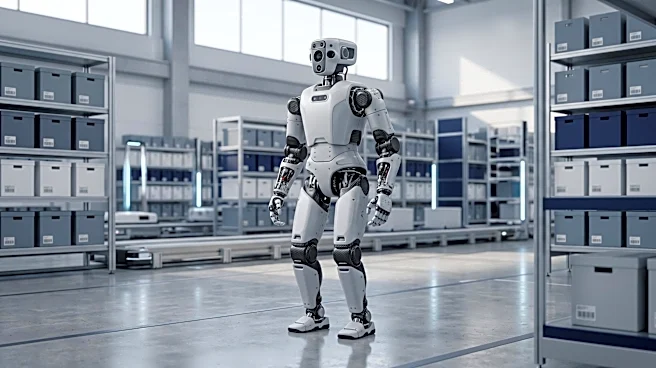
Skild AI is actively recruiting a Robotics Engineer specializing in Manipulation for an on-site position in San Mateo, California. The company is focused on developing a singular, general-purpose robotic intelligence designed to operate across a variety
of robot bodies. This advanced AI aims to be robust and adaptable, capable of handling unforeseen scenarios without failure. A primary application for this technology is mobile manipulation, indicating Skild AI's ambition to create highly versatile and intelligent robotic systems. The role involves contributing to the core manipulation work that underpins this ambitious project, which seeks to revolutionize how robots interact with and adapt to diverse environments. This hiring initiative underscores the company's commitment to advancing the field of robotics through innovative AI solutions.
Why It's Important?
This development is significant for the robotics and artificial intelligence sectors in the U.S., particularly in California's tech hub. Skild AI's pursuit of a 'general-purpose robot brain' represents a major step towards more autonomous and adaptable robotic systems, moving beyond task-specific automation. Such technology could have profound implications across various industries, including manufacturing, logistics, healthcare, and service sectors, by enabling robots to perform a wider range of complex tasks with greater flexibility. The ability of robots to adapt to unseen scenarios without failure could lead to increased efficiency, reduced operational costs, and enhanced safety in environments where human intervention is currently required. This advancement could also spur further innovation and competition within the robotics industry, attracting more investment and talent to the field.
What's Next?
The immediate next step for Skild AI is to successfully fill the Robotics Engineer, Manipulation position, which will be crucial for advancing their core development goals. Once the team is augmented, the company will likely intensify its research and development efforts on the general-purpose robot brain, focusing on refining its adaptability and robustness across different robot platforms. Future developments could include testing prototypes in various real-world or simulated environments to validate the AI's capabilities in mobile manipulation and other applications. Success in this endeavor could lead to further hiring, strategic partnerships, or even pilot programs with companies looking to integrate advanced robotic intelligence into their operations. The progress of Skild AI will be closely watched as it could set new benchmarks for robotic autonomy and versatility.
Beyond the Headlines
The long-term implications of a truly general-purpose robot brain extend beyond immediate industrial applications. Such a breakthrough could fundamentally alter the nature of work, potentially automating complex tasks previously thought to require human cognitive abilities. Ethically, the development of highly adaptable AI raises questions about job displacement, the need for new skill sets in the workforce, and the societal impact of increasingly autonomous machines. Legally, the responsibility and accountability of robots operating with such advanced intelligence in unforeseen situations will become a critical area of discussion and regulation. Culturally, the integration of robots capable of learning and adapting could shift human-robot interactions, potentially leading to new forms of collaboration or even societal integration. Skild AI's work could be a precursor to a future where robots are not just tools but intelligent agents capable of navigating and influencing complex environments.