





What's Happening?
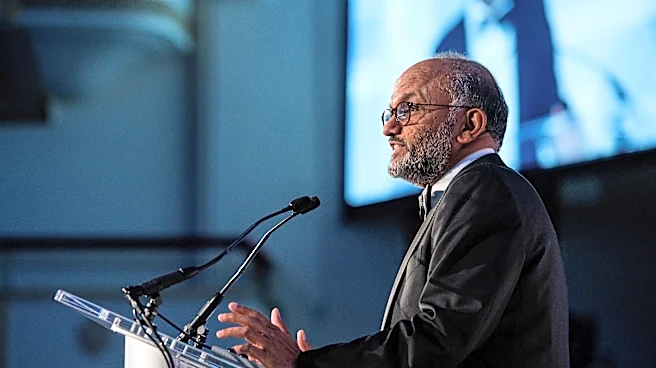
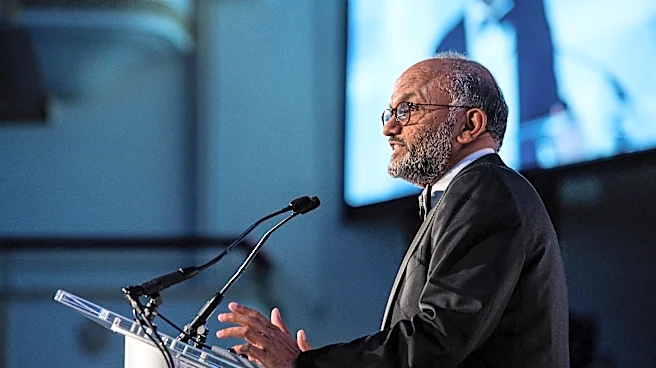
Adobe is undergoing a significant leadership change, with Shantanu Narayen transitioning from chief executive to executive chair. Anil Chakravarthy is set to assume the role of CEO on December 1. This transition occurs as Adobe continues to report strong
financial performance, with fiscal Q3 revenue increasing by 12.89% to $6.76 billion, surpassing the consensus estimate. Non-GAAP EPS for Q3 reached $6.13, marking the sixth consecutive beat. Management has also raised its full-year non-GAAP EPS guidance to between $24.45 and $24.50. Despite these positive financial indicators, Adobe's stock has experienced a decline, falling 5.02% over the past week and 8.67% over the past month, and is down 35.52% year-to-date. The company's AI-first Annual Recurring Revenue (ARR) has topped $650 million, representing a growth of over 150% year-over-year, and its Firefly ending ARR grew 40% quarter-over-quarter.
Why It's Important?
This leadership transition at Adobe is significant for the U.S. business landscape, particularly within the technology and software sectors. Shantanu Narayen's move to executive chair and Anil Chakravarthy's appointment as CEO signal a strategic shift as the company aims to further capitalize on its artificial intelligence initiatives. The market's current undervaluation of Adobe's stock, despite its robust earnings and substantial AI growth, presents a critical juncture. Investors are seemingly underestimating the company's potential, as evidenced by its forward P/E ratio near 8x, which suggests an expectation of structural decline. However, Adobe's strong user base, with over 1 billion monthly active users and more than 100 million creative freemium users, provides a significant opportunity for monetization, especially if these freemium users convert to paid subscriptions. The success of this conversion and the new CEO's execution of the AI strategy will determine whether Adobe can close the valuation gap with competitors like Microsoft and Salesforce, who currently trade at higher multiples despite Adobe's superior operating margins.
What's Next?
Anil Chakravarthy will officially take over as CEO on December 1, and his leadership will be closely watched, particularly regarding the monetization of Adobe's extensive user base and the continued growth of its AI-first offerings. The company's performance in Q4, specifically if revenue lands within the guided range of $6.80 billion to $6.85 billion and if freemium users begin converting to paid ARR, will be a key indicator for investors. Conversely, a continued shrinking of organic net new ARR under the new CEO could lead to increased caution from the market. The success of Adobe's AI strategy, particularly with Firefly, and how quickly it monetizes, will be crucial for its future stock performance. The company's decision to delay Creative Cloud price increases to prioritize user growth suggests a long-term strategy that relies on converting these users into paying customers through credit packs, premium tiers, and usage-based contracts, which could expand margins.
Beyond the Headlines
The leadership change at Adobe, coupled with the market's apparent underestimation of its AI potential, highlights a broader trend in the technology sector where traditional software giants are navigating the rapid evolution of artificial intelligence. The transition from a long-standing CEO to a new leader often brings shifts in strategic focus and operational execution. For Adobe, this means a heightened emphasis on 'agentic software for creativity, productivity, and customer experience,' as articulated by Chakravarthy. The challenge lies in convincing a skeptical Wall Street that its AI growth is sustainable and will translate into significant financial returns, especially when compared to competitors with higher valuations. This situation also underscores the ongoing debate about how to accurately value companies that are heavily investing in and transitioning towards AI-driven business models, particularly when their stock performance doesn't immediately reflect their underlying technological advancements and user engagement.