







What's Happening?
Anthropic, a leading artificial intelligence company, has filed its initial public offering (IPO) registration statement with the U.S. Securities and Exchange Commission, outlining plans for substantial expansion in the life sciences sector. The company intends
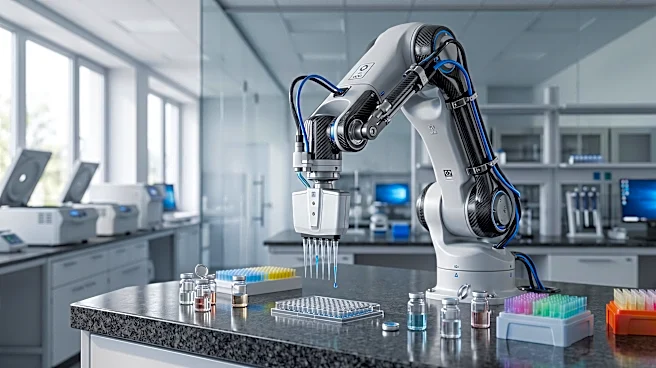
to invest further in knowledge, talent, partnerships, and acquisitions to grow its presence in this field. Anthropic's Claude family of large language models is already being utilized in drug discovery and development by customers, biotechnology partners, and its own researchers. The IPO filing highlights the development of AI agents capable of operating lab and manufacturing equipment, such as microscopes, liquid handlers, and robotic arms, through its Model Hardware Standard (MHS). Additionally, Anthropic released Claude Science, an AI workbench consolidating scientific research tools and databases for genomics, proteomics, and structural biology. The company reported a net loss of $80.748 billion in the first half of 2026, despite revenue leaping 14-fold to $16.286 billion in the same period.
Why It's Important?
Anthropic's aggressive push into life sciences through AI signifies a major convergence of advanced technology and biological research, with profound implications for the U.S. healthcare and pharmaceutical industries. By leveraging AI to accelerate drug discovery, development, and even physical lab work, Anthropic aims to revolutionize how new therapies are created, potentially reducing costs and speeding up the time-to-market for life-saving medications. This could lead to significant advancements in treating diseases and improving public health. The company's focus on automating physical tasks in labs could also address labor shortages and increase efficiency in research. For investors, the IPO represents a high-stakes opportunity in the rapidly expanding AI market, particularly in a sector with immense societal and economic impact. The involvement of major financial institutions like Goldman Sachs and Morgan Stanley underscores the perceived value and potential of this integration.
What's Next?
Following its IPO, Anthropic is expected to intensify its efforts in life sciences, potentially announcing new partnerships, acquisitions, and research initiatives. The company will likely continue to refine its AI models and hardware standards to enhance their capabilities in operating lab equipment and processing complex biological data. The success of its AI agents in discovering novel enzyme systems, as previously reported, suggests a future where AI plays an increasingly autonomous role in scientific breakthroughs. The financial performance post-IPO will be closely watched, especially given the substantial net losses despite revenue growth, indicating a period of heavy investment in R&D. The company's ability to translate its AI advancements into tangible, marketable solutions in the life sciences will be critical for its long-term success and market valuation.
Beyond the Headlines
The integration of advanced AI into life sciences raises several deeper implications. Ethically, the development of AI that can autonomously discover and manipulate biological systems prompts discussions about responsible innovation, potential misuse, and the need for robust regulatory frameworks. The 'Model Hardware Standard' for AI agents operating physical lab equipment could lead to a redefinition of scientific experimentation, where human scientists collaborate with or oversee AI systems rather than performing all tasks manually. This shift could also exacerbate existing inequalities in scientific research, as access to such advanced AI tools might be concentrated among well-funded institutions. Culturally, it challenges traditional notions of scientific discovery, moving towards a future where AI is not just a tool but an active participant in generating new knowledge, potentially accelerating the pace of scientific progress beyond current human capabilities.