









What's Happening?
Researchers from University College London and London South Bank University have utilized the QuEra Aquila neutral-atom quantum system to develop a framework for extracting thermodynamic properties of materials, specifically focusing on nitrogen-doped
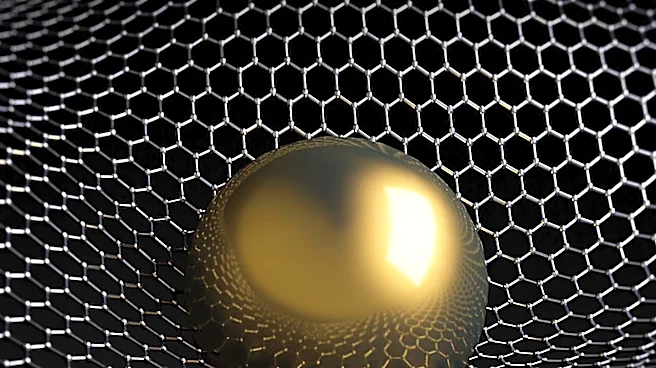
graphene. The study involved scaling the system to 78 sites and using Monte Carlo sampling to confirm the preferential sampling of low-energy configurations. The research required a rescaling strategy to align the hardware's energy scale with the material's properties, ensuring accurate simulations. This work represents a significant step in using quantum computing to model complex materials, moving beyond theoretical exercises to practical applications.
Why It's Important?
This development is crucial for the field of quantum computing and materials science, as it demonstrates the potential of quantum systems to simulate complex material behaviors. The ability to accurately model materials like nitrogen-doped graphene could lead to advancements in material design and innovation, impacting industries such as electronics, energy, and manufacturing. The research also highlights the growing capabilities of neutral-atom quantum hardware, which could revolutionize how scientists approach material simulations and other complex computational problems.
What's Next?
Future research will likely focus on expanding the capabilities of quantum systems to handle even larger and more complex material simulations. As the technology matures, it could lead to breakthroughs in understanding and designing new materials with tailored properties. Continued collaboration between academic institutions and technology companies will be essential to drive these advancements and integrate quantum computing into mainstream scientific research.