






What's Happening?
Luxury handbags and jewelry connected to a $3 billion money laundering case were sold at auction for more than $1.1 million. The auction, managed by Deloitte for the Singapore Police Force, included 337 lots from prominent brands such as Chanel, Louis
Vuitton, and Christian Dior. Some items fetched prices significantly exceeding their initial estimates. For instance, a Chrome Hearts diamond double cross pendant necklace, estimated between $1,000 and $1,500, sold for $11,000. A rare Christian Dior mini handbag made of crocodile skin with a matte gradient white and grey Himalayan finish garnered $20,000, surpassing its $10,000 to $15,000 estimate. The highest bid for a single item was $87,000 for a limited-edition Louis Vuitton pumpkin bag, a collaboration with Japanese artist Yayoi Kusama, which had been estimated at $12,000 to $16,000. This strong interest in luxury goods contrasts with a previous auction of properties linked to the same case, where no bids met the reserve prices.
Why It's Important?
This auction highlights the enduring demand and perceived value of luxury goods, even when associated with illicit activities. The significant prices achieved, often far exceeding estimates, underscore the robust market for high-end fashion accessories and jewelry. This event also sheds light on the process of asset recovery in major financial crime cases, demonstrating how seized assets are liquidated to contribute to public funds. The disparity between the successful luxury goods auction and the unsuccessful property auction suggests differing market dynamics and investor confidence in these asset classes. For the luxury market, it reinforces the idea that certain brands and limited-edition items retain or even increase in value, attracting competitive bidding regardless of their provenance. The proceeds from such sales contribute to the Consolidated Fund, providing a tangible outcome from law enforcement efforts against financial crime.
What's Next?
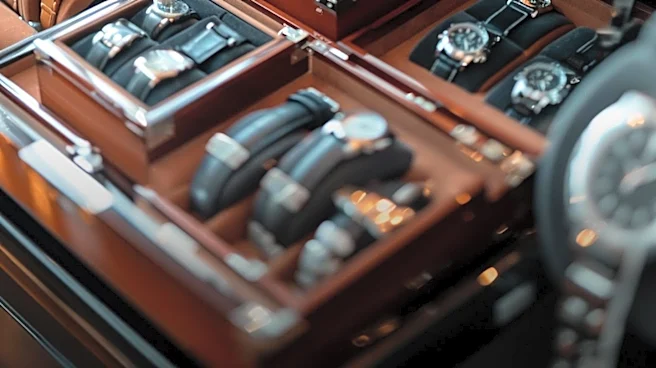
The current auction represents the first phase of liquidating assets seized in the $3 billion money laundering case. A separate auction for 286 pieces of jewelry is scheduled to conclude on September 27, with a 15.02-carat 'fancy yellow' diamond ring already attracting a $190,000 offer. Further auctions for other seized items, including watches, Hermes handbags, and alcohol, are slated to begin on November 9. These upcoming sales will continue the process of converting seized assets into funds, with all proceeds directed to the Consolidated Fund. The ongoing auctions will provide further insights into the market value of various luxury items and the effectiveness of asset recovery strategies in large-scale money laundering cases. The outcome of these future auctions will also indicate whether the strong demand seen in the initial luxury goods sale is a consistent trend.
Beyond the Headlines
The auction of these luxury items, despite their connection to a $3 billion money laundering case, raises questions about the ethical considerations and public perception surrounding such sales. While the proceeds benefit the Consolidated Fund, the act of purchasing items previously owned by individuals involved in illicit activities could be viewed differently by various segments of society. It also underscores the dual nature of luxury goods as both status symbols and potential vehicles for money laundering, highlighting the challenges law enforcement faces in tracking and seizing such high-value, easily transferable assets. The strong bidding, particularly for rare and limited-edition items, suggests that the allure of exclusivity and brand prestige often outweighs concerns about an item's past ownership, reflecting a complex interplay of market forces, consumer desire, and the broader implications of financial crime.