



What's Happening?
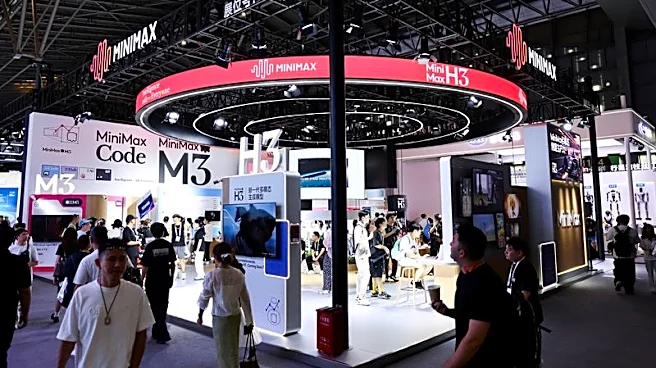
MiniMax has announced the release of its H3 Family of AI models, which includes the flagship H3 and H3-Image series, alongside a range of extended models. This development follows the open-sourcing of MiniMax H3, which has led to the creation of 1,472
derivative models downloaded over 148 million times. The H3 Family aims to provide enhanced capabilities for multimodal creation, with models designed for various commercial productions. The flagship H3 model prioritizes image quality for high-end productions, offering 2K or 768P output. H3-Highspeed balances speed and cost for daily commercial work, generating five-second clips in approximately 11 seconds. H3-Lite offers a lower-cost option for testing ideas and producing repetitive commercial material. The H3-Image series focuses on fast generation and high image quality, with H3-Image Highspeed capable of generating 4K images in under 10 seconds. These models are accessible through the MiniMax Open Platform and other platforms, fostering an ecosystem where developers can build and innovate.
Why It's Important?
The introduction of the H3 Family by MiniMax signifies a significant advancement in the field of AI-driven multimodal content creation. By offering a diverse range of models tailored for different needs—from high-fidelity commercial productions to cost-effective ideation and rapid image generation—MiniMax is democratizing access to advanced AI tools. This expansion is crucial for industries such as e-commerce, gaming, film and TV, animation, and industrial design, where the demand for high-quality, scalable content is ever-increasing. The open-source nature of the initial H3 model has already demonstrated its potential to foster innovation, with numerous companies and research institutions developing specialized applications. The H3 Family's enhanced capabilities in understanding nuanced artistic directions and precise editing instructions will enable creators to produce more sophisticated and tailored content, potentially reducing production times and costs across various sectors. This move also strengthens MiniMax's position as a key player in the evolving AI ecosystem, encouraging further collaboration and development within the community.
What's Next?
MiniMax plans to continue open-sourcing its work and supporting developers in their creation with the H3 series, aiming to build a defining community for multimodal creation in the AI era. The company is actively welcoming H3-based derivative models into the H3 Family, with partnerships open to developers and companies globally. This indicates a future where more specialized AI models, built upon the H3 foundation, will emerge to address specific industry needs. Developers with new ideas for video generation in AI avatars, film and TV, e-commerce, and gaming are invited to build custom models on H3 and become partners. MiniMax also encourages participation in the H3 community through discussion groups and other channels. The ongoing commitment to open-sourcing models and improving tools suggests a continuous evolution of the platform, aiming to empower individuals and teams to solve business problems more efficiently and benefit from the growing open-source community around multimodal AI.
Beyond the Headlines
The expansion of the MiniMax H3 Family extends beyond mere technological advancement; it represents a significant shift towards a more collaborative and accessible AI development landscape. The emphasis on an open ecosystem, where developers can build upon existing models and contribute their innovations, fosters a decentralized approach to AI progress. This model could lead to a rapid acceleration in the development of highly specialized AI applications that cater to niche markets and creative demands, which might otherwise be overlooked by larger, more generalized AI systems. Furthermore, the focus on understanding subtle artistic nuances and precise editing instructions in models like H3 suggests a move towards AI that can act as a true creative partner rather than just a tool. This could redefine workflows in creative industries, allowing artists and designers to focus on conceptualization while AI handles the intricate execution. The ethical implications of such powerful content generation tools, particularly concerning authenticity and potential misuse, will also become increasingly important as these technologies become more widespread and sophisticated.