






What's Happening?
Cambricon Technologies Corporation Limited, a Chinese AI chip manufacturer, experienced a significant stock decline of 6.36% in Hong Kong trading. This downturn occurred as investors shifted capital away from AI hardware companies towards discounted Chinese internet
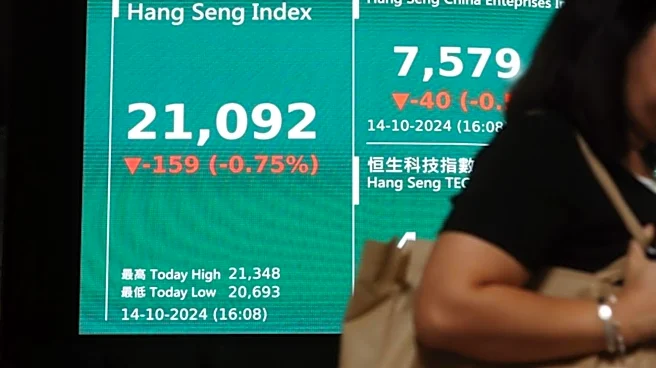
platforms. The broader Hong Kong market saw a strong rebound, with the Hang Seng Tech Index climbing 5.6%, its largest gain since February 2025. This market rotation was partly triggered by the U.S. midterm election results, which led to a broader shift from AI-related stocks to value and consumer shares in Asian markets. While internet giants like Alibaba and Tencent saw substantial gains, AI hardware firms, including Cambricon, faced considerable selling pressure, indicating a re-evaluation of market segments within the Chinese tech sector. Cambricon, headquartered in Beijing, specializes in semiconductors and AI chips, having raised $1.69 billion in funding from investors including the Chinese Academy of Sciences and Alibaba Group. The company is listed on the Shanghai Stock Exchange (688256.SS) and is a key player in China's AI chip competitive landscape.
Why It's Important?
The sell-off in AI hardware companies like Cambricon highlights a significant shift in investor sentiment within the Chinese technology market, moving away from what was perceived as a crowded AI hardware trade. This rotation indicates that investors are becoming more selective, prioritizing businesses with proven monetization, broad consumer reach, and strong cash flow visibility over pure AI hardware plays. For the U.S., this trend could signal evolving global investment strategies, where capital flows are increasingly sensitive to macro-economic signals and valuation discipline. While Cambricon primarily operates within China, its performance reflects broader market dynamics affecting the global semiconductor and AI industries. U.S. companies in the AI hardware sector might observe similar shifts in investor behavior, emphasizing the need for diversified portfolios and robust business models beyond speculative growth. The increased precision with which investors are now differentiating between hardware cyclicals and internet leaders suggests a maturing market that values durable operating models.
What's Next?
The immediate future will likely see continued scrutiny of valuation discipline within the AI hardware sector, both in China and potentially globally. Investors will be watching whether the rotation into internet platforms is a sustained trend or a short-term correction. For Cambricon and other Chinese AI chip manufacturers, the focus will be on demonstrating strong fundamentals, expanding market share, and navigating U.S. export controls and the domestic software ecosystem challenges. The sustainability of the broader Hong Kong market rally will depend on continued buying from mainland investors through Stock Connect, which would signal renewed confidence in China's digital champions. If this trend persists, it could lead to a re-allocation of capital across global tech markets, with implications for U.S. tech companies that have seen significant investment in AI hardware. Companies will need to adapt their strategies to meet evolving investor expectations, potentially emphasizing profitability and market stability over rapid, unproven growth.
Beyond the Headlines
This market rotation underscores deeper implications regarding the maturity of the AI industry and investor perception of technological innovation. The initial enthusiasm for AI hardware may be giving way to a more pragmatic assessment of where value truly lies within the AI ecosystem. This shift could prompt a re-evaluation of investment priorities, moving towards AI applications and platforms that demonstrate clear commercial viability and integration into existing economic structures. For the U.S., this could mean increased focus on software, services, and integrated AI solutions rather than solely on chip manufacturing. Furthermore, the differentiation between hardware and software within the AI sector highlights the growing complexity of the technology market, where a 'one-size-fits-all' investment approach is becoming less effective. Ethical and legal considerations surrounding AI development, data privacy, and intellectual property will also continue to shape investment decisions, influencing which companies and segments attract capital in the long term.