







What's Happening?
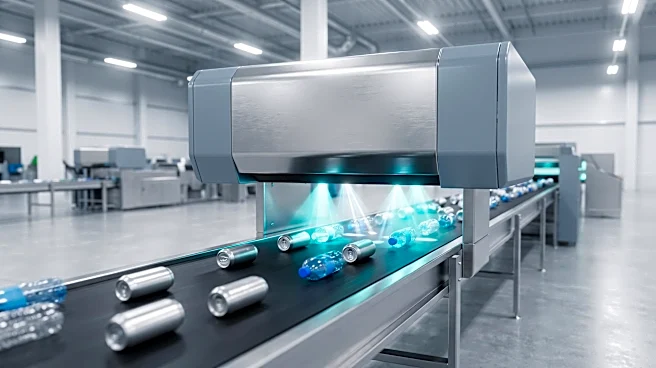
California Waste Solutions is implementing significant technology upgrades at its material recovery facilities in the Bay Area. The company is expanding its Pellenc optical-sorting capacity at the Timothy MRF in San Jose and installing EverestLabs artificial
intelligence (AI) scanners at the 10th Street MRF in Oakland. The San Jose upgrade aims to increase the facility's ability to recognize materials, recover targeted commodities, and produce cleaner output streams by enhancing existing optical sorters. In Oakland, the new AI scanners will identify and report items entering the container line before they are disposed of, providing detailed data on material flow and potential loss points. These initiatives are designed to improve the identification of recoverable materials, enhance the quality of sorted products, and provide facility teams with better information to optimize operations.
Why It's Important?
These technological advancements by California Waste Solutions are crucial for the U.S. recycling industry, which constantly seeks to improve efficiency and material recovery rates. By expanding optical sorting, the company can process more recyclables with greater accuracy, leading to higher purity levels in sorted materials. This directly impacts the economic viability of recycling, as cleaner materials command better prices in the market. The introduction of AI scanning offers a new level of data-driven insight into the recycling stream, allowing operators to identify inefficiencies and make informed adjustments to their processes. This can significantly reduce the amount of recyclable material sent to landfills, contributing to environmental sustainability and resource conservation. The ability to track material flow and identify recurring patterns of loss empowers facility teams to optimize equipment settings and sorting conditions, ultimately improving overall recovery performance.
What's Next?
California Waste Solutions plans to leverage the data generated by the new EverestLabs AI scanners to inform future investment decisions, potentially including robotic sorting or additional optical sorting. This measured approach ensures that subsequent technological integrations are strategically aligned with identified operational needs, maximizing their impact on recovery and efficiency. The company anticipates that the enhanced visibility into the recycling stream will enable employees to make more effective adjustments to operations, leading to continuous improvement. Other recycling facilities across the U.S. may observe the outcomes of these upgrades, potentially influencing their own adoption of similar AI and advanced sorting technologies. The ongoing evolution of packaging formats and material mixes will necessitate continuous adaptation and innovation in recycling processes, making these types of technology investments increasingly vital.
Beyond the Headlines
The integration of AI and advanced optical sorting in recycling facilities like those of California Waste Solutions has broader implications for waste management and environmental policy. Ethically, it underscores a commitment to responsible resource management and reducing environmental impact. Legally, as these technologies become more prevalent, there may be a need for updated standards and regulations regarding data collection, privacy, and the performance metrics of recycling facilities. Culturally, increased efficiency in recycling can foster greater public trust and participation in recycling programs, reinforcing the importance of individual contributions to sustainability. This development also highlights a long-term trend towards automation and data analytics in traditionally labor-intensive industries, potentially reshaping the workforce and requiring new skill sets for employees. The ability to precisely measure and optimize recovery rates could also influence policy decisions regarding extended producer responsibility and material design for recyclability.