





What's Happening?
The Asia Culture Center (ACC) has opened a large-scale sound installation by artist Kim Young-eun, titled '2026 ACC Future Prize: Kim Young-eun — To Future Listeners: Moving Sounds.' The exhibition, running from September 3rd through February 14th, 2027,
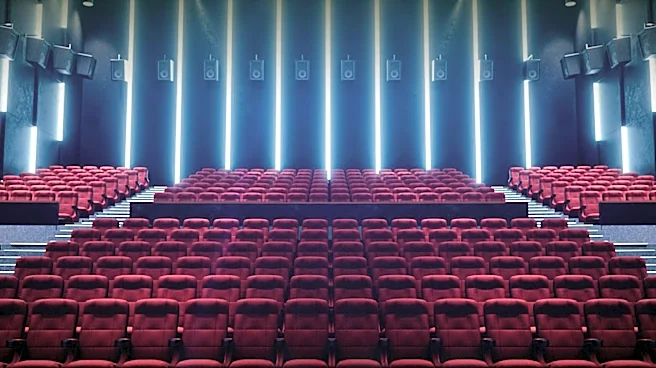
features 115 speakers installed across a vast exhibition space, measuring 25 meters wide, 60 meters deep, and 15 meters high. Kim Young-eun, who won the ACC Future Prize last October and the National Museum of Modern and Contemporary Art's Artist of the Year award in February, explores narratives often overlooked in vision-centered history through sound and listening. The installation allows visitors to experience movement and migration in Asia through sound, with voices and poems from the past that capture emotions of displacement amid historical events like colonial violence and war. The work incorporates nine pieces based on nine poems, playing on a 60-minute loop, and includes collaborations with composers to create a new sonic landscape of Asia. Three large screens display lines from the poems, complemented by lighting design to present the sonic landscape in three dimensions.
Why It's Important?
This exhibition is significant as it highlights the innovative use of sound art to explore complex historical and social narratives, offering a unique sensory experience that challenges traditional visual-centric interpretations of history. Kim Young-eun's work, by focusing on auditory experiences, provides a platform for stories of movement and migration in Asia that might otherwise remain unheard, fostering a deeper understanding of cultural heritage and human experiences. The scale and technical ambition of the installation, with 115 speakers, demonstrate a cutting-edge approach to immersive art, pushing the boundaries of how audiences interact with artistic content. For the ACC, this exhibition reinforces its role in identifying and supporting artists who create original works in convergence art, positioning it as a hub for contemporary artistic innovation. The recognition of Kim Young-eun through the ACC Future Prize and Artist of the Year award also elevates her status as a mid-career Korean artist with global potential, contributing to the international art discourse.
What's Next?
The exhibition '2026 ACC Future Prize: Kim Young-eun — To Future Listeners: Moving Sounds' will continue to run until February 14th, 2027, offering an extended period for public engagement. The ACC will likely monitor visitor reception and critical acclaim, which could influence future programming and support for similar innovative art forms. Kim Sang-wook, president of the Asia Culture Center, expressed hope that the exhibition will help Kim Young-eun grow into a world-class master, suggesting potential for further international collaborations or exhibitions for the artist. The success of this large-scale sound installation may also encourage other cultural institutions to explore and invest in immersive, multi-sensory art experiences. The exhibition's focus on Asian history and migration through sound could also spark further academic and artistic discussions on these themes, potentially leading to new research or creative projects.
Beyond the Headlines
The exhibition delves into the profound implications of sound and listening as primary modes of historical and social understanding, challenging the dominance of visual culture. By reconstructing the 'lost vocality' of past poems and narratives, Kim Young-eun's work offers an alternative way to connect with history, emphasizing the emotional and bodily sensations that sound can evoke. This approach has ethical dimensions, as it seeks to give voice to experiences of displacement and colonial violence that might be marginalized in conventional historical accounts. The use of advanced technology, such as 115 speakers and sophisticated lighting design, to create an immersive sonic landscape, also raises questions about the future of art and how technology can enhance human perception and empathy. The exhibition's focus on Asian history and migration also contributes to a broader global conversation about identity, belonging, and the impact of historical events on contemporary societies, fostering cross-cultural understanding through artistic expression.