



What's Happening?
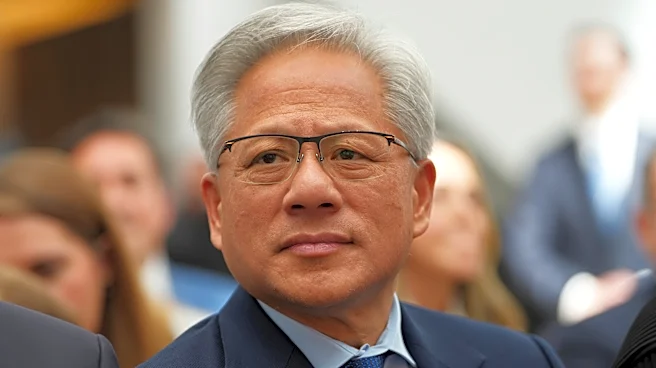
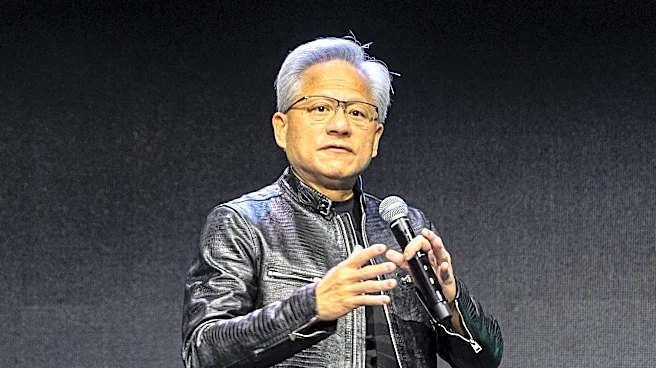
Wall Street is increasingly concerned about NVIDIA's revenue exposure to China following revelations regarding CEO Jensen Huang's alleged involvement with a suspected Chinese spy. A Monday analysis from New Street Research estimates that as much as 10%
of NVIDIA's total expected fiscal year 2027 revenue, amounting to between $37 billion and $47 billion out of $411 billion, may come directly or indirectly from China. This includes 6% from 'legal sales' into China and Hong Kong, and an additional 4% from sales booked outside China, with half of that estimated to be physically diverted into China and the other half used by 'Chinese-controlled offshore capacity.' The U.S. maintains export controls on some of NVIDIA's high-tech chips, and the Commerce Department had reportedly been investigating the company where the suspected Chinese spy was an executive before transferring the probe to the Justice Department.
Why It's Important?
NVIDIA is a pivotal company in the global artificial intelligence (AI) buildout, and its significant revenue exposure to China, coupled with the ongoing investigation into its CEO, raises serious concerns about national security and compliance with U.S. export controls. The potential for a crackdown on NVIDIA's business operations in China could severely impact its financial performance and market position. The U.S. government's efforts to restrict China's access to advanced semiconductor technology are a key component of its geopolitical strategy, and any perceived circumvention of these controls by a major U.S. company could lead to heightened regulatory scrutiny and penalties. This situation underscores the complex challenges U.S. tech companies face in balancing global market opportunities with national security imperatives.
What's Next?
The ongoing investigation by the Justice Department and the Commerce Department's prior probe into the company linked to the suspected Chinese spy suggest a sustained focus on NVIDIA's China-related activities. Investors will be closely monitoring any official statements or regulatory actions that could impact NVIDIA's ability to conduct business in or with China. The company's commitment to compliance with U.S. laws, as stated at its 2026 annual shareholders meeting, will be tested. The outcome of these investigations could lead to stricter enforcement of export controls, potentially forcing NVIDIA to re-evaluate its supply chain and sales strategies in the region. This could also influence broader U.S. policy on technology exports and foreign investment.
Beyond the Headlines
The situation highlights the intricate web of economic interdependence and geopolitical competition between the U.S. and China, particularly in critical technology sectors like AI. The alleged diversion of chips and the involvement of a suspected foreign agent underscore the persistent challenges in enforcing export controls and preventing technology transfer. This could lead to a re-evaluation of existing compliance mechanisms and potentially the development of more robust international frameworks to safeguard sensitive technologies. Furthermore, it could accelerate the trend of 'decoupling' in the tech sector, as both nations seek to secure their supply chains and reduce reliance on each other for strategic components. The incident serves as a stark reminder of the national security implications embedded within global business operations.