




What's Happening?
Vornado Realty Trust, a real estate investment trust primarily focused on commercial properties in New York City, reported a significant increase in its third-quarter funds from operations (FFO). The company's FFO rose to $126.6 million, an increase from $114.5
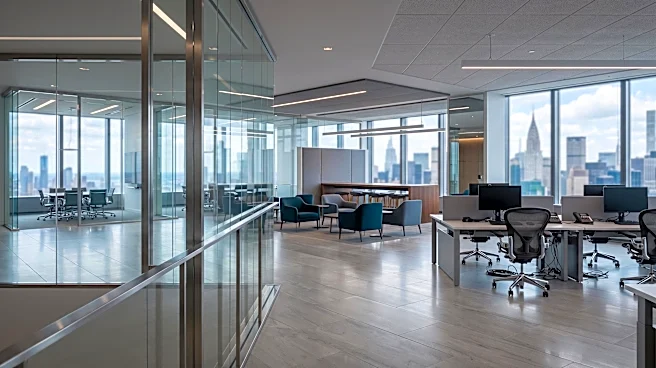
million in the same period last year. This growth was largely attributed to a surge in Manhattan leasing activity, which CEO Steven Roth described as the strongest he has seen. Vornado completed 30 Manhattan office deals during the quarter, totaling 489,000 square feet, with average starting rents of $123 per square foot and average terms of 9.5 years. The company also noted that its New York office same-store net operating income (NOI) increased by 11.9% on a GAAP basis. Vornado ended the quarter with $1.9 billion in liquidity, comprising $724 million in cash and restricted cash, and $1.2 billion in undrawn credit lines. Additionally, two potential asset sales are in advanced stages and could generate over $1 billion in 'new free cash' if finalized.
Why It's Important?
The strong performance of Vornado Realty Trust signals a robust recovery and strengthening in the Manhattan office market, particularly for premier spaces. This indicates a 'landlord's market,' where demand for high-quality office space is accelerating, availability of large blocks is limited, and rents are rising. This trend is crucial for the U.S. commercial real estate sector, as Manhattan is a key economic hub. The increased leasing activity and rising rents suggest that businesses are increasingly committing to physical office spaces, potentially reversing or stabilizing previous concerns about remote work impacts. For Vornado, this translates into improved financial health, with higher FFO and liquidity, which can support further development and strategic investments. The potential asset sales could further bolster the company's financial position, providing capital for future projects or debt reduction. This positive outlook for a major REIT in a critical market could influence investor confidence in the broader real estate investment trust sector.
What's Next?
Vornado expects its full-year 2026 comparable FFO to surpass 2025 levels, with management anticipating continued earnings growth through 2028 and beyond. The company projects approximately 2.4 million square feet of New York office leasing in 2026, including a significant 1.05 million-square-foot lease with Citadel at 350 Park Avenue, which is expected to be recognized in the fourth quarter. Vornado also plans to commence construction early next year on the redevelopment of retail spaces along Seventh Avenue and 34th Street, as well as a 480-unit rental residential building at 34th Street and Eighth Avenue, with units expected to be delivered in late 2028 or early 2029. The completion of the two potential asset sales, which could generate over $1 billion, remains a key factor, though not assured. These developments suggest a continued focus on high-value projects and strategic growth in the New York market.
Beyond the Headlines
The reported surge in Manhattan office leasing by Vornado Realty Trust highlights a significant 'flight to quality' trend in the commercial real estate market. This implies that while overall office demand might be evolving due to hybrid work models, there is a strong and growing preference among tenants for modern, well-located, and amenity-rich spaces. This trend could lead to a widening disparity between premium and older, less-equipped office buildings, potentially accelerating the obsolescence of the latter. The emphasis on large-scale redevelopment initiatives, such as those in the Penn District, suggests a long-term vision for urban revitalization and the creation of integrated live-work-play environments. This could have broader implications for urban planning and infrastructure development in major U.S. cities, as companies like Vornado invest heavily in transforming urban landscapes to meet evolving business and lifestyle needs. The success of these projects could set a precedent for future urban development strategies.