

What's Happening?
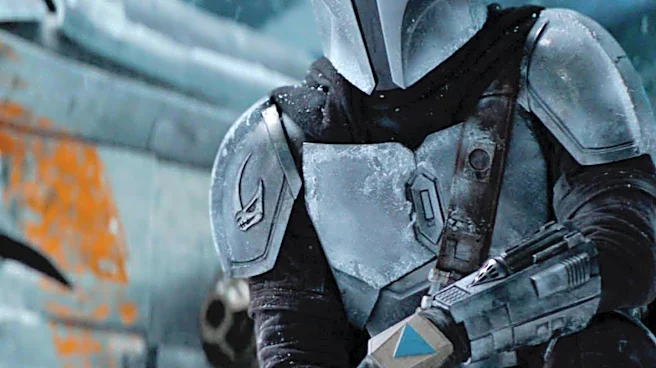
Charles Alleneck, a digital artist and animator at Industrial Light & Magic (ILM) for over 25 years, recently discussed his work on "The Mandalorian and Grogu" and the Oscar-winning film "Rango." Alleneck highlighted the unique approach required for animation
in live-action films compared to traditional animated features. He explained that while the 12 animation principles (such as arcs, appeal, and follow-through) still apply, animation integrated into live-action needs an added layer of 'grit,' irregularity, and imperfection to appear believable. This involves incorporating subtle, almost random forces that make the animation slightly less than perfect, preventing it from looking too 'cartoony' against real-world footage. He also shared insights into working with director Jon Favreau, who is known for his collaborative approach and encyclopedic film knowledge, often providing film references to guide the animation team's vision.
Why It's Important?
This discussion sheds light on the intricate and often subtle challenges faced by animators working on high-profile live-action productions. The need to blend animation seamlessly with live-action footage is critical for maintaining audience immersion and the overall believability of the cinematic experience. Alleneck's insights underscore the technical and artistic sophistication required to achieve this, moving beyond mere technical proficiency to a nuanced understanding of realism and imperfection. This approach is vital for the success of major franchises like Star Wars, where iconic characters and creatures must feel like integral parts of the live-action world. The emphasis on 'dirtying up' animation to match live-action aesthetics influences industry standards and techniques, pushing the boundaries of visual effects and contributing to the evolution of filmmaking. It also highlights the collaborative nature of film production, where animators work closely with directors to realize a cohesive artistic vision.
What's Next?
The continuous evolution of technology in visual effects and animation suggests that the techniques discussed by Alleneck will continue to be refined and expanded. As new tools and software emerge, animators will likely find even more sophisticated ways to integrate animated elements into live-action, making the distinction between the two increasingly blurred. The industry will continue to seek artists who possess not only technical skills but also a deep understanding of physical realism and artistic nuance. Future projects, especially those within established universes like Star Wars, will likely build upon these principles, striving for even greater levels of photorealism and immersive storytelling. The ongoing demand for high-quality visual effects in blockbusters will ensure that the art of blending animation with live-action remains a critical and evolving aspect of filmmaking.
Beyond the Headlines
Alleneck's perspective on the role of technology as merely a 'tool' rather than a replacement for human talent offers a deeper insight into the creative process in the digital age. He acknowledges the initial pushback against new technologies like motion capture or CG animation, but emphasizes that these are ultimately evolutionary steps that enhance the capabilities of artists. This perspective is crucial in an era where discussions about AI and automation often raise concerns about job displacement in creative fields. Alleneck's experience suggests that while technology provides new means, the fundamental principles of art, storytelling, and human aesthetic judgment remain indispensable. This highlights the enduring value of human creativity and expertise in guiding technological applications, ensuring that the 'aesthetic calls' are still made by talented individuals who understand how things should move and interact, regardless of the tools employed.