


What's Happening?
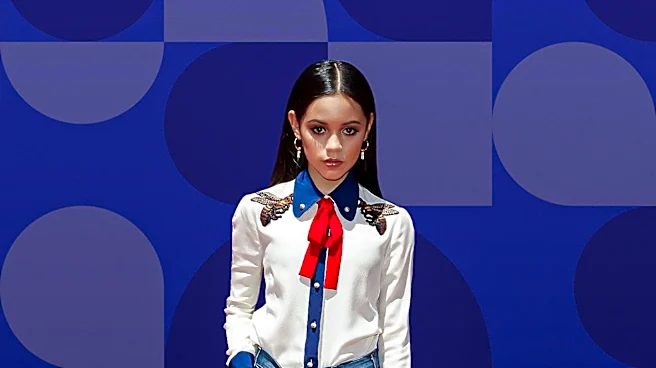
American actress Jenna Ortega, known for her role in the Netflix series 'Wednesday,' has revealed her deliberate strategy to protect her mental health by not watching her own films, reading reviews, or tracking box office numbers. Ortega stated that engaging
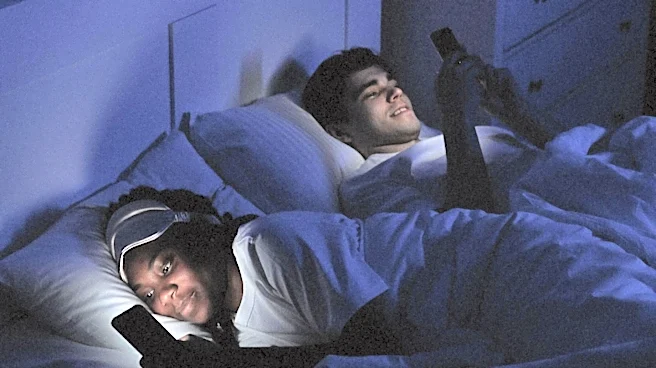
with such feedback could lead to 'a kind of psychosis.' She also expressed a desire to avoid reducing the success of her projects solely to financial metrics. In addition to these practices, Ortega has significantly reduced her social media activity. She noted that a substantial portion of current social media content is 'junk generated by artificial intelligence,' which has contributed to her decreased engagement. Ortega also believes that individuals often place too much emphasis on their online personas. She recently experienced a period without her phone, which she found to be a liberating experience, allowing her to navigate daily tasks without constant digital access.
Why It's Important?
Ortega's approach highlights a growing concern among public figures regarding the impact of constant scrutiny and digital overload on mental well-being. Her decision to disengage from traditional metrics of success and public opinion offers a model for managing the pressures of fame in the digital age. This stance could influence other celebrities and individuals to re-evaluate their relationship with social media and external validation. Furthermore, her critique of AI-generated content on social media underscores a broader societal issue concerning the proliferation of inauthentic digital information and its potential to dilute genuine human interaction and content. Her experience without a smartphone also speaks to a desire for digital detox and a return to more present and independent living, which resonates with a public increasingly aware of screen time's effects.
What's Next?
It is likely that Ortega will continue to maintain her current practices of limiting exposure to self-critique and social media, reinforcing her commitment to mental health. Her public statements may encourage more open discussions within the entertainment industry about the psychological toll of fame and the need for coping mechanisms. Other public figures might adopt similar strategies, leading to a broader trend of celebrities disengaging from traditional feedback loops. The conversation around AI-generated content on social media is also expected to intensify, with more individuals and platforms potentially addressing the issue of authenticity and content quality. Ortega's advocacy for reduced screen time could also inspire more public figures to share their experiences with digital detox, potentially influencing broader societal attitudes towards technology use.
Beyond the Headlines
Ortega's actions reflect a deeper cultural shift where individuals, particularly those in the public eye, are actively seeking ways to reclaim personal boundaries and mental autonomy in an increasingly interconnected and critical world. Her rejection of box office numbers as the sole measure of success challenges the commercialized nature of the entertainment industry, suggesting a value system that prioritizes artistic integrity and personal well-being over purely financial outcomes. The concern about AI-generated content points to an evolving digital landscape where distinguishing between authentic and artificial information is becoming more complex, raising questions about media literacy and the future of online discourse. Her personal anecdote about breaking her phone and experiencing freedom without it touches upon a fundamental human desire for disconnection and presence, offering a counter-narrative to the pervasive digital dependency in modern society.