








What's Happening?
The formal structure of the PAD/NASP shipping service has undergone a significant change, with CMA CGM becoming the sole operator. Previously, the service was run as a vessel sharing agreement between CMA CGM and Marfret. This reorganization was prompted
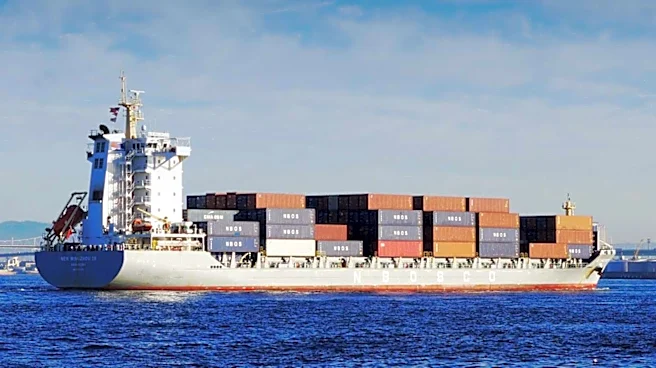
by difficult circumstances at the Panama Canal, as stated by Marfret. Under the new arrangement, Marfret's sole ship, the 2,506 TEU Marius, has been chartered to CMA CGM for 12 months, effective from its Melbourne call on October 20. Marfret will now operate as a slot-charterer on the service, with Seaway Agencies continuing to represent Marfret in Australia. The change was first revealed through a filing with the U.S. Federal Maritime Commission last week. The service has also implemented a new off-season structure that temporarily removes the Atlantic leg for six months.
Why It's Important?
This shift in the PAD/NASP service structure highlights the significant impact of global logistical challenges, particularly those affecting the Panama Canal, on international shipping and U.S. trade. The Panama Canal's reduced capacity due to lower water levels, exacerbated by the El Niño climate phenomenon, and increased demand from LNG carriers and tankers, has made securing transit slots increasingly difficult and expensive. Marfret's decision to charter its vessel to CMA CGM, leveraging CMA CGM's higher ranking for canal passage slots, underscores the critical need for reliability in supply chains. For U.S. businesses and consumers, disruptions in major shipping routes like the Panama Canal can lead to increased shipping costs, longer transit times, and potential delays in the delivery of goods, affecting various industries that rely on maritime trade. The U.S. Federal Maritime Commission's involvement in the filing of this change indicates the regulatory oversight of such significant operational adjustments in international shipping services that impact U.S. commerce.
What's Next?
Marfret has emphasized that despite the operational changes, there will be no alteration to cargo and booking arrangements for its customers. The chartering of the Marius to CMA CGM for 12 months is a temporary measure designed to ensure the regularity of the service by benefiting from CMA CGM's higher ranking for Panama Canal passage slots. This suggests that the current arrangement will remain in place for at least a year, subject to ongoing conditions at the Panama Canal and the broader maritime market. Stakeholders, including shippers and logistics providers, will likely monitor the effectiveness of this new structure in maintaining service reliability and managing costs. Future decisions regarding the service's structure will depend on the long-term outlook for Panama Canal transit capacity and the overall stability of global shipping routes. The U.S. Federal Maritime Commission will continue to oversee such filings, ensuring compliance with shipping regulations.
Beyond the Headlines
The reorganization of the PAD/NASP service reflects a broader trend in the maritime industry where carriers are adapting to unprecedented environmental and geopolitical pressures. The Panama Canal's water scarcity, a direct consequence of climate change and weather patterns, is forcing shipping lines to re-evaluate their strategies and potentially incur higher operational costs or seek alternative routes. This situation also highlights the interconnectedness of global trade and environmental factors, where localized climate phenomena can have far-reaching economic implications. The reliance on 'ranking' for canal passage slots underscores the competitive nature of the shipping industry and the advantages held by larger carriers. This could lead to further consolidation or strategic alliances as smaller operators seek to mitigate risks and maintain service levels. The ethical dimension arises in how the industry balances economic viability with environmental sustainability, especially as climate change continues to impact critical infrastructure like the Panama Canal.