





What's Happening?
Takaya Awata, founder and CEO of Toridoll Holdings Corp., a Japanese company with nearly $1.8 billion in annual revenue, is aiming to elevate udon noodles into a major global fast-food category, comparable to burgers, chicken, and pizza. His primary focus
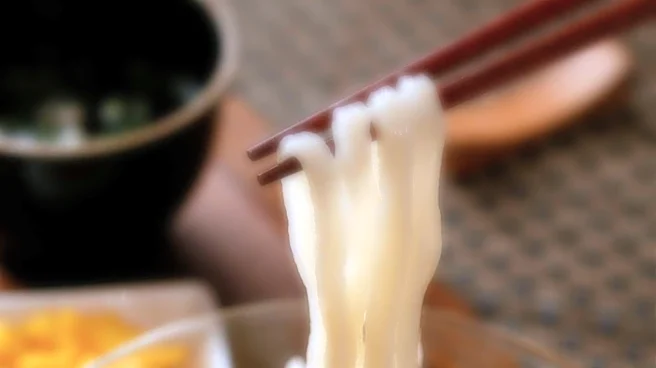
for this expansion is the U.S. market. Toridoll's flagship brand, Marugame Udon, currently operates almost 2,100 restaurants globally, with over 40% located outside Japan, including a couple dozen locations on the U.S. West Coast. Awata, who started his first restaurant in 1985 and opened the first Marugame Udon in 2000, has accumulated a net worth of approximately $1 billion through this venture. The company's strategy involves maintaining its hallmark of making noodles from scratch in every restaurant, visible to customers, to ensure the prized elastic texture known as 'koshi.' This approach, while seemingly inefficient, is considered a competitive strength.
Why It's Important?
This initiative is significant for the U.S. fast-food industry and consumer market as it attempts to introduce a new staple cuisine on a large scale. If successful, it could diversify the American fast-food landscape, offering consumers a different culinary option beyond established categories. The U.S. market presents both immense opportunity and considerable challenges, including higher labor costs and rents compared to Japan. Previous attempts by other Japanese fast-food chains like MOS Burger and Dosanko to penetrate the U.S. market have faced difficulties, highlighting the competitive nature and unique consumer preferences in the U.S. However, Marugame Udon's existing West Coast locations are performing well, with some ranking among Toridoll's top 10 highest-selling globally by revenue, indicating potential for broader acceptance. The expansion could also create new jobs and stimulate economic activity in the regions where new restaurants are established.
What's Next?
Toridoll Holdings Corp. plans to gradually expand its Marugame Udon presence inland and eastward across more U.S. states, building on the success of its West Coast operations. The company is open to acquisitions as a strategy to gain market positions more quickly than organic growth would allow. To manage costs while maintaining its fresh noodle preparation, Toridoll is implementing automation in back-end operations, such as using artificial intelligence for demand forecasting, staffing, and inventory management. The company also aims to broaden its appeal to American consumers by offering menu items not typically found in Japan, such as shredded cheese toppings and deep-fried omelets. Awata anticipates that overseas revenue will eventually surpass domestic sales, driven by the growth potential in markets like the U.S. compared to Japan's shrinking population and workforce.
Beyond the Headlines
The effort to establish udon as a global fast-food category reflects a broader trend of international culinary exchange and the increasing mainstream acceptance of diverse food cultures in the U.S. The success of Marugame Udon hinges not only on its operational efficiency and product quality but also on its ability to adapt to American tastes while preserving the authenticity of its Japanese heritage. The emphasis on making noodles from scratch in front of customers taps into a desire for transparency and fresh preparation, which can be a significant draw for consumers. This expansion also highlights the cultural dimension of food, where a dish deeply rooted in one culture seeks to find a new identity and widespread appeal in another. The challenges faced by previous Japanese chains in the U.S. underscore the complexities of cultural translation in the food industry, where subtle differences in flavor, service, and dining experience can determine success or failure.