
What's Happening?
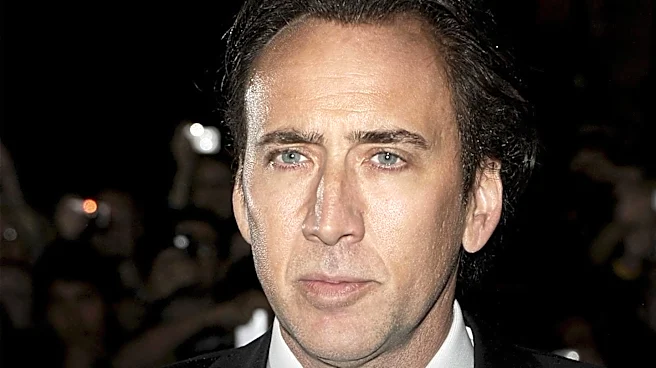
Actor Nicolas Cage has spoken about the difficulties he faced early in his career due to being the nephew of acclaimed director Francis Ford Coppola. Born Nicolas Kim Coppola, he felt compelled to work
twice as hard to prove his merit, often encountering skepticism that his opportunities stemmed solely from his family connections. Cage recalled instances where his relation to Francis Ford Coppola led to mockery on film sets, such as during his 1982 debut in 'Fast Times at Ridgemont High'. He adopted the professional surname 'Cage' to distance himself from his famous family, a change he legally finalized in 2025. Despite the initial challenges, Cage acknowledged that his upbringing with Francis and Eleanor Coppola exposed him to significant artistic influences, which he credited for cultivating his appreciation for art. His uncle later cast him in several films, and even celebrated Cage's Oscar win for 'Leaving Las Vegas' with a congratulatory telegram.
Why It's Important?
This revelation from Nicolas Cage highlights the complex dynamics of nepotism within the entertainment industry, particularly for individuals from highly influential families. While a famous surname can open doors, it can also create immense pressure and the need to constantly validate one's talent independently. Cage's decision to change his name underscores a desire for individual recognition and to forge a career based on his own abilities rather than inherited status. His experience reflects a broader discussion about privilege and meritocracy in Hollywood, where family ties can be both an advantage and a burden. For aspiring actors and industry professionals, Cage's story serves as a reminder that even with powerful connections, personal effort and skill are crucial for sustained success and respect.
What's Next?
While Nicolas Cage has long established himself as a prominent actor, his recent reflections may prompt further discussions within the entertainment industry regarding the experiences of individuals from famous families. This could lead to more open conversations about the pressures faced by 'nepo babies' and how the industry perceives and treats them. For Cage himself, these insights add another layer to his public persona, offering fans a deeper understanding of his journey and motivations. As he continues his career, his past struggles with his family name will likely remain a part of his narrative, potentially influencing how his future roles and performances are interpreted by audiences and critics alike.
Beyond the Headlines
Nicolas Cage's narrative extends beyond a simple tale of overcoming family shadow; it delves into the psychological impact of public perception and the quest for self-identity within a highly scrutinized profession. His choice to legally change his name, years after adopting it professionally, signifies a profound desire to fully own his identity and achievements. This act can be seen as a statement against the inherent biases that often accompany inherited fame, suggesting a deeper struggle for authenticity. Culturally, it reflects the enduring American ideal of the self-made individual, even when starting from a position of privilege. Legally, the formal name change solidifies his professional identity, separating his public persona from his birthright and reinforcing his artistic independence.