







What's Happening?
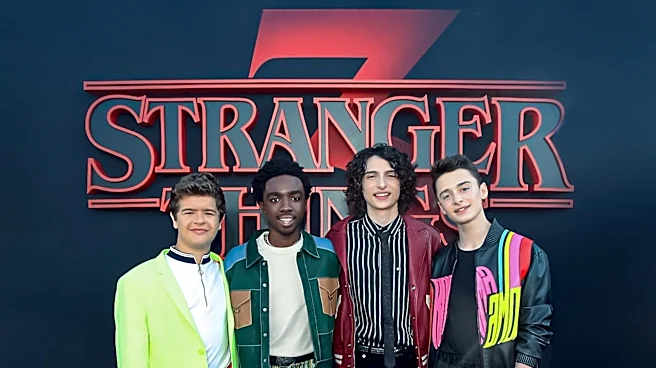
Actor Jake Busey, known for his roles in 'Starship Troopers' and as Bruce Lowe in the third season of Netflix's 'Stranger Things', has discussed how his character in the latter series reflects the corporate climate of the 1980s. In interviews from 2018
with ComicBook.com and Bloody Disgusting, Busey described his 'Stranger Things' character, Bruce Lowe, as a 'crass newsman' who embodies the 'old boys club' mentality prevalent in the 80s workplace. He noted that women in corporate settings were still a relatively new concept, leading to condescending attitudes from some men. Busey highlighted how this portrayal demonstrates the significant cultural shifts and progress made in America over the past 30 years. His character in 'Stranger Things' ultimately meets a grim end, being possessed by the Mind Flayer and killed by Nancy Wheeler.
Why It's Important?
Busey's reflections on his 'Stranger Things' character underscore the cultural evolution within American society and workplaces. The portrayal of Bruce Lowe serves as a historical mirror, illustrating the challenges women faced in professional environments during the 1980s and the societal norms that permitted such behavior. This perspective is important as it highlights how far American culture has progressed in terms of gender equality and workplace conduct. For younger audiences, it provides a tangible example of past societal attitudes, fostering a greater appreciation for current advancements. For older generations, it offers a moment of reflection on the changes witnessed and the ongoing efforts towards a more inclusive society. The discussion also emphasizes the role of entertainment in reflecting and commenting on social history, making historical contexts accessible and relatable to a broad audience.
What's Next?
While Busey's specific role in 'Stranger Things' has concluded, the broader conversation about societal change and the representation of historical norms in media is ongoing. Future productions, particularly those set in past decades, are likely to continue exploring and depicting evolving social dynamics. This trend suggests a continued focus on historical accuracy in cultural portrayals, prompting further discussions about progress and remaining challenges in areas like gender equality and workplace ethics. Audiences can anticipate more nuanced character developments that reflect the complexities of different eras, encouraging critical engagement with both historical and contemporary social issues. The entertainment industry will likely continue to use its platform to both entertain and educate on these important societal shifts.
Beyond the Headlines
The discussion surrounding Jake Busey's character in 'Stranger Things' extends beyond mere entertainment, touching upon deeper sociological and ethical implications. The character of Bruce Lowe, as a representation of 1980s corporate misogyny, serves as a cultural artifact that allows for an examination of how societal values and norms have transformed. This portrayal can spark conversations about the long-term impact of such attitudes on individuals and institutions, and how these historical patterns continue to influence contemporary issues like gender pay gaps and workplace harassment. It also highlights the power of popular culture to not only entertain but also to educate and provoke thought on complex social issues, fostering a collective understanding of historical injustices and the ongoing journey towards a more equitable society. The show's ability to weave these social commentaries into its narrative enriches its cultural significance.