

What's Happening?
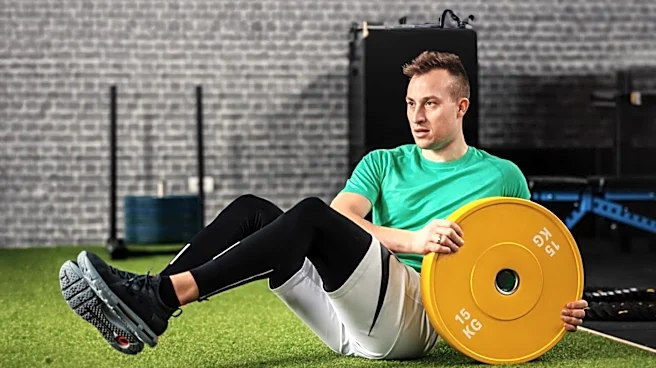
Men's Health highlights the seated overhead plate raise as an effective exercise for building deltoids (delts) and trapezius (traps) muscles using lighter weights. This technique involves sitting upright on a bench, holding a weight plate with both hands
between the legs, and raising it from in front of the thighs to fully overhead. The seated position minimizes momentum from the lower body, ensuring that the shoulders and traps do the primary work. Extending the movement overhead, beyond the traditional front raise, engages the traps and muscles controlling the shoulder blades, providing a comprehensive workout for both muscle groups from a single plate. This method is praised for its efficiency and ability to create significant challenge with modest loads due to the long lever and extended range of motion.
Why It's Important?
This exercise offers a valuable solution for individuals in the U.S. seeking to build shoulder and trap strength without needing heavy weights or extensive gym equipment. Its efficiency, working multiple muscle groups simultaneously, makes it ideal for time-constrained workouts or home fitness routines. For the fitness industry, promoting such techniques can broaden accessibility to strength training, as it reduces the barrier of requiring heavy equipment. It also emphasizes the principle of 'time under tension' and proper form over simply lifting the heaviest possible weight, which can lead to safer and more effective muscle development. This approach can help prevent injuries often associated with attempting to lift excessive weights with poor form, making strength training more sustainable for a wider population.
What's Next?
Fitness enthusiasts and trainers may increasingly incorporate the seated overhead plate raise into their routines, recognizing its benefits for targeted muscle growth and efficiency. Gyms and fitness programs might highlight this exercise as a way to achieve significant results with minimal equipment. Further instructional content and demonstrations could emerge to ensure proper form and maximize the exercise's effectiveness. The emphasis on making lighter weights work harder could also influence the design of home workout equipment and programs, catering to individuals who prefer not to use very heavy loads.
Beyond the Headlines
The seated overhead plate raise exemplifies a broader trend in fitness towards smarter, more functional training that prioritizes muscle activation and range of motion over sheer weight. This shift reflects a growing understanding of biomechanics and the importance of engaging stabilizing muscles. It also challenges the 'bigger is better' mentality often prevalent in weightlifting culture, promoting a more nuanced approach to strength development. By demonstrating that significant gains can be made with lighter loads and proper technique, this exercise encourages a more mindful and sustainable approach to physical training, potentially reducing the incidence of ego-driven injuries and fostering a greater appreciation for controlled, precise movements. This could lead to a more inclusive fitness culture where effectiveness is valued over brute force.