






What's Happening?
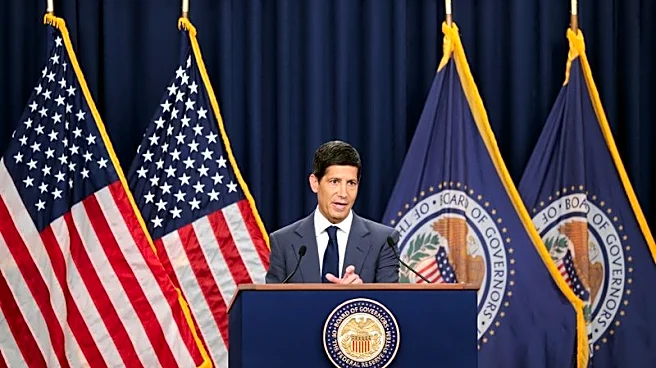
Federal Reserve Vice Chair Philip Jefferson, speaking at the UC San Diego Economic Roundtable on November 13, 2026, discussed the current state of productivity growth in relation to artificial intelligence (AI). Jefferson referenced a 39-year-old book
review, echoing the sentiment that while AI is pervasive, its tangible impact on aggregate productivity statistics remains unclear. He noted that productivity growth has increased in recent years, but it is premature to definitively attribute this to AI. This perspective aligns with observations from other economists, including Apollo Chief Economist Torsten Slok and St. Louis Fed president Alberto Musalem, who have similarly highlighted the discrepancy between AI's widespread presence and its measurable economic effects. Historically, U.S. nonfarm business labor productivity saw significant growth from 1947 to 1973, then slowed, before experiencing a surge from 1995 to 2004, following the widespread adoption of personal computers. Jefferson's remarks suggest a similar 'Solow paradox' might be at play with AI, where technological advancements are visible everywhere except in the official productivity numbers.
Why It's Important?
The discussion surrounding AI's impact on productivity is crucial for understanding the future trajectory of the U.S. economy and informing monetary policy decisions. If AI does not translate into significant productivity gains, it could mean that current economic growth is driven by other factors, such as capital deepening, rather than a fundamental technological shift. This distinction is vital for policymakers like the Federal Reserve, as different drivers of growth require different policy responses. A lack of broad-based productivity improvement from AI could lead to sustained inflationary pressures if demand outstrips supply without corresponding efficiency gains. Conversely, if AI eventually delivers substantial productivity boosts, it could lead to higher living standards and lower inflation in the long run. The current uncertainty makes it challenging for businesses to plan long-term investments and for the government to forecast tax revenues and allocate resources effectively. The 'Solow paradox' highlights a potential disconnect between technological innovation and its economic measurement, which could lead to misinterpretations of economic health and future potential.
What's Next?
The ongoing debate about AI's productivity impact will likely continue to be a key focus for economists and policymakers. Future data releases from the Bureau of Labor Statistics (BLS) on nonfarm business productivity and total factor productivity (TFP) will be closely watched to see if AI's influence becomes more evident. Economists like Erik Brynjolfsson and Robert Gordon have ongoing 'Long Bets' regarding productivity growth, which will be settled by future BLS reports. The concentration of AI gains in specific sectors, particularly software-heavy industries, will also be a critical area of observation. If AI's benefits remain confined to a few digital industries, it suggests a more limited economic transformation compared to a widespread impact across all sectors. Additionally, the efficiency of engineering teams and the actual 'shipping' of software versus the volume of code generated will be monitored to understand if bottlenecks in the development pipeline are hindering broader productivity gains. The Census Bureau's Business Trends and Outlook Survey (BTOS) and other executive surveys will provide insights into AI adoption rates and perceived productivity lifts across U.S. firms.
Beyond the Headlines
Beyond the immediate economic statistics, the 'Solow paradox' in the context of AI raises deeper questions about how we measure and perceive technological progress. The analogy to the electric dynamo, which took decades to fully transform manufacturing productivity, suggests that the full impact of AI might not be realized for many years, requiring significant reorganization of workflows and business models. The current bottlenecks in software development, such as code review and verification, highlight that simply generating more code with AI does not automatically translate into more shipped products or increased user value. This points to a need for systemic changes in how organizations integrate AI, moving beyond mere automation of individual tasks to a holistic rethinking of processes. The ethical and societal implications of AI, including its potential impact on employment and the nature of work, are also critical long-term considerations that extend beyond current productivity metrics. The challenge lies in adapting human systems and organizational structures to fully leverage AI's potential, rather than simply bolting new technology onto old frameworks.