






What's Happening?
Following a significant leadership reversal at Nvidia, where CEO Jensen Huang resigned and was subsequently reinstated, investors are re-evaluating semiconductor stocks, with particular attention on Taiwan Semiconductor Manufacturing Company (TSMC). Nvidia's
stock experienced volatility due to reports of Huang's personal conduct and President Trump's reported intervention in his reinstatement. This broader market uncertainty, coupled with a general sell-off in the semiconductor sector, led to TSMC shares falling approximately 35% from their highs before a partial recovery. Despite these market fluctuations, TSMC's fundamentals remain strong, with continued demand for its leading-edge manufacturing processes from major clients like Nvidia, AMD, Apple, and Broadcom. Investors are now looking past the headlines to TSMC's core business strength and its valuation, which some assess as being below its historical median.
Why It's Important?
TSMC's position as a near-monopoly in advanced chip manufacturing makes its performance and valuation critical for the global technology sector, especially given the ongoing buildout of AI and high-performance computing hardware. The company's resilience amidst market volatility and leadership changes at key clients like Nvidia underscores its strategic importance. A stable and robust TSMC is essential for the continued innovation and supply of advanced semiconductors that power numerous industries. The investor focus on TSMC's valuation, which is seen as potentially undervalued compared to its historical price-to-earnings ratio, suggests a belief in its long-term growth trajectory, driven by its extensive capacity expansion plans and its indispensable role in the semiconductor supply chain. Any significant shift in TSMC's operational stability or market perception could have ripple effects across the entire tech ecosystem.
What's Next?
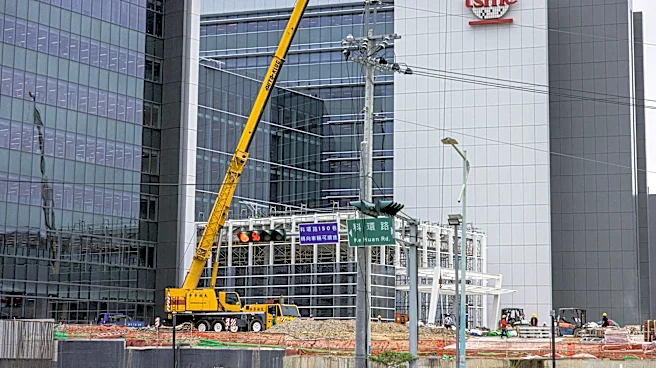
TSMC is actively expanding its manufacturing capacity, with nearly 20 fabrication and advanced-packaging facilities in progress worldwide, including 13 in Taiwan and several planned overseas. This expansion is crucial to meet the sustained demand for advanced chips, particularly those used in AI infrastructure. Investors will closely monitor TSMC's upcoming quarterly results and capital spending updates to validate the growth assumptions built into its current valuation. The company's ability to execute these ambitious expansion plans and maintain its technological lead will be key to its future performance. Furthermore, the broader geopolitical landscape, particularly the stability across the Taiwan Strait, remains a central risk factor that investors will continue to assess, as any disruption could severely impact TSMC's operations and the global semiconductor supply.
Beyond the Headlines
The renewed investor interest in TSMC, despite broader market uncertainties and geopolitical risks, highlights the company's unique and defensible position in the semiconductor industry. Its 'manufacturing moat' is considered wider than that of many chip designers, making it less susceptible to cyclicality and competitive pressures. The reliance of major tech giants on TSMC for physically producing their advanced chips underscores its critical role, almost akin to a utility in the digital age. The geopolitical risk associated with Taiwan remains a significant, albeit often discounted, factor. While some investors view Taiwan's strategic importance as a deterrent to potential aggression, the lack of formal alliance guarantees means this remains a probability judgment. The ongoing saga at Nvidia and President Trump's reported intervention also raise broader governance questions about political influence in corporate decisions, setting a precedent that could invite further scrutiny in the future.