






What's Happening?
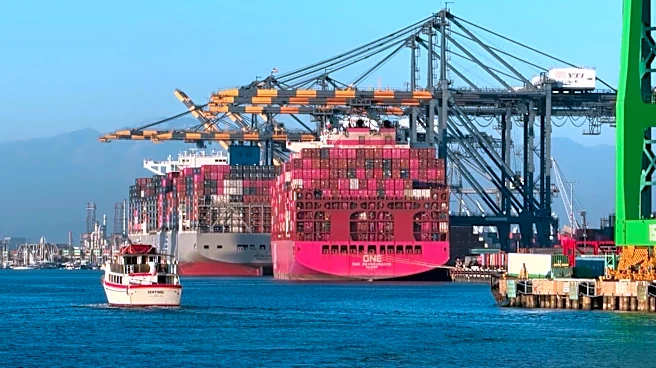
The Canadian federal government has officially designated the Roberts Bank Terminal 2 project at the Port of Vancouver as a project of national interest. This strategic move aims to bolster Canada's trade infrastructure and decrease its economic dependence
on the U.S. market. According to Transport Canada, this initiative is a key component of Canada's broader strategy to double its exports to non-U.S. markets by 2035. The project, which involves a planned investment of 5.9 billion Canadian dollars (approximately 4.2 billion U.S. dollars), is projected to increase the Port of Vancouver's container capacity by about 50 percent. This expansion will add 2.4 million containers of annual processing capacity and is expected to support up to 100 billion Canadian dollars (71.55 billion U.S. dollars) in annual trade. The designation provides regulatory certainty, aiming to accelerate the project's commercial operations to 2035, four years ahead of schedule, with a Final Investment Decision anticipated by mid-2027.
Why It's Important?
This Canadian government decision holds significant implications for U.S. economic stakeholders and trade relations. By actively seeking to reduce reliance on the U.S. market, Canada's actions could lead to a re-evaluation of existing trade agreements and supply chain dynamics between the two nations. U.S. businesses that heavily depend on Canadian imports or exports, particularly those routed through the Port of Vancouver, may need to anticipate shifts in trade volumes and logistics. The increased capacity at the Port of Vancouver could also enhance Canada's competitiveness in global trade, potentially diverting some international shipping traffic that might otherwise pass through U.S. ports. While Canada aims to diversify its trade partners, U.S. industries could face both challenges and opportunities, depending on how these new trade routes and partnerships evolve. The move underscores a broader trend among nations to strengthen their own economic resilience and reduce single-market dependencies, which could influence future U.S. trade policy and strategic planning.
What's Next?
The Roberts Bank Terminal 2 project is on track for a Final Investment Decision by mid-2027, with commercial operations targeted for 2035. This timeline suggests that the full impact of Canada's trade diversification strategy will unfold over the next decade. U.S. policymakers and trade organizations will likely monitor the progress of this project and its effects on cross-border trade flows. Businesses involved in U.S.-Canada trade, particularly in sectors like manufacturing, agriculture, and technology, may begin to explore alternative logistics and market strategies to adapt to Canada's evolving trade landscape. The Canadian government's continued efforts to expand its non-U.S. export markets could also prompt discussions on enhancing U.S. trade infrastructure and competitiveness to maintain its position as a primary trade partner.
Beyond the Headlines
The Canadian government's initiative to reduce reliance on the U.S. market through port expansion highlights a subtle but significant shift in international trade dynamics. This move reflects a growing global trend towards economic nationalism and the strengthening of domestic infrastructure to secure national interests. Beyond the immediate economic impacts, it could foster a more diversified global supply chain, potentially reducing vulnerabilities associated with over-reliance on any single trading partner. For the U.S., this development could serve as a catalyst for re-evaluating its own trade policies and investments in port infrastructure, ensuring its continued competitiveness and resilience in a changing global economy. The long-term implications could include a more balanced North American trade relationship, where Canada's increased autonomy in trade could lead to both greater collaboration and strategic competition.