






What's Happening?
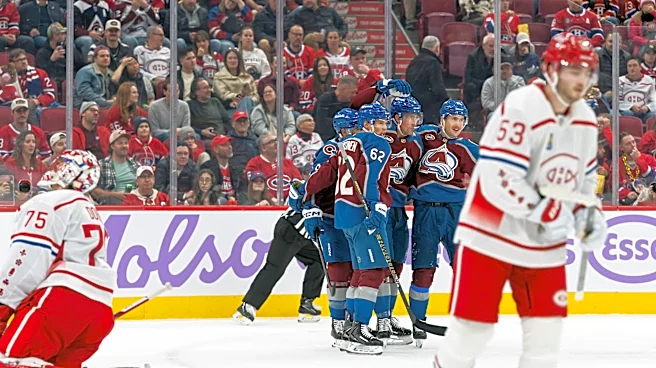
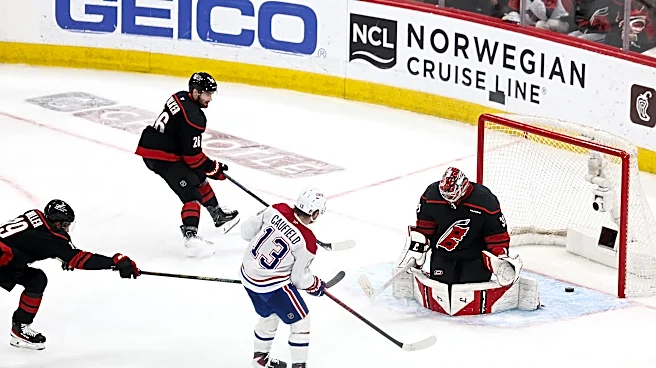
The Montreal Canadiens, despite possessing significant offensive talent including 51-goal scorer Cole Caufield and dynamic defenseman Lane Hutson, are experiencing one of the NHL's least productive power plays. A quarter of the way into the season, the team
has converted only eight out of 64 power-play opportunities, resulting in a success rate of 12.5%. This places them second-to-last in the league, just ahead of Ottawa. The struggles were particularly evident in a recent loss to the New York Rangers, where the Canadiens went 0-for-4 on the power play and conceded a short-handed goal. The team is currently in an 0-for-12 drought on the power play, which began on November 7 against Toronto. Coach Martin St. Louis acknowledged the rising pressure and stress among players due to the lack of production, noting that the power play was successful last season with a 23.1% conversion rate.
Why It's Important?
The Canadiens' power-play inefficiency is a critical issue that could significantly impact their performance and standing in the NHL. A strong power play is often a key differentiator in close games, providing opportunities to capitalize on opponent penalties and build momentum. For a team with touted offensive players like Caufield and Hutson, the inability to convert power-play chances represents a missed opportunity to leverage their talent. This struggle can also have a psychological effect on the team, as captain Nick Suzuki noted that power-play difficulties can 'bleed into your five-on-five play.' If the team cannot resolve these issues, it could lead to a decline in overall team confidence and performance, potentially affecting their playoff aspirations and fan engagement. The financial implications for the franchise could also be significant if sustained poor performance impacts attendance and merchandise sales.
What's Next?
Coach Martin St. Louis plans to address the power-play issues through conversations, teaching, and practice sessions. He and captain Nick Suzuki have already begun reviewing recent power plays to identify areas for improvement. The team's top power-play unit, comprising Hutson, Caufield, Suzuki, Juraj Slafkovský, and Zack Bolduc, has been criticized for not shooting the puck enough, often passing up good opportunities in search of better ones. Conversely, shooting too quickly and missing the net, as seen with Alex Newhook's shot that led to a Rangers' short-handed goal, also needs to be corrected. The focus will be on improving execution and decision-making to restore player confidence and return the power play to its previous effectiveness. The team believes the issue lies more with player execution than with the underlying structure, suggesting that internal adjustments rather than major strategic overhauls will be the primary approach.
Beyond the Headlines
The Canadiens' power-play struggles highlight a common challenge in professional sports: the psychological impact of performance slumps, even for highly skilled athletes. The 'pressure rises' and 'stress level goes up' as described by Coach St. Louis, indicating that mental fortitude and confidence are as crucial as physical skill. This situation also underscores the delicate balance between individual talent and team synergy. Despite having individual offensive stars, the collective execution of the power play is faltering, suggesting a breakdown in communication, timing, or strategic adherence. The team's reliance on 'finding a way to get them comfortable' points to the importance of coaching in fostering a supportive environment where players can regain their confidence and perform optimally under pressure. This scenario could serve as a case study for how even minor inefficiencies in specialized team plays can have disproportionate effects on overall game outcomes and team morale.