






What's Happening?
PepsiCo recently increased its quarterly dividend by 4% to $1.48, following a similar move by McCormick. This dividend hike comes as the company reported a 3.1% organic revenue growth and a 2% rise in core EPS to $2.34 for the third quarter. However,
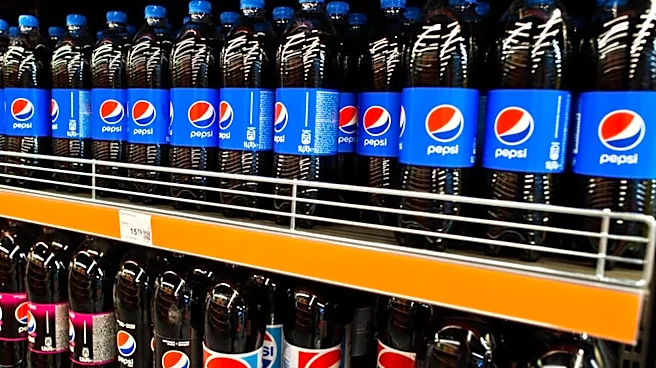
PepsiCo's management has revised its fiscal 2026 core EPS growth guidance downwards, from the lower end of 5%-7% to 2.5%-3.5%. This adjustment is attributed to rising input costs. A significant area of concern highlighted by CEO Ramon Laguarta during the third-quarter call is the underperformance of North America soft drinks, with Laguarta stating dissatisfaction with the U.S. market's results. Despite these challenges, PepsiCo's dividend payout over the past twelve months to September 16 represented a manageable 75% of its free cash flow, totaling $7.88 billion out of $10.47 billion. The company's operating cash flow has shown improvement, reaching $7.95 billion in the first 36 weeks of fiscal 2026, up from $5.47 billion in the prior year.
Why It's Important?
PepsiCo's decision to raise its dividend despite cutting its long-term earnings per share growth guidance signals a strategic balance between returning value to shareholders and acknowledging operational headwinds. The reduced EPS growth forecast reflects the broader economic pressures of increasing input costs, which can impact profitability across various industries. The specific weakness in the North America soft drinks market is particularly significant for PepsiCo, as it points to potential shifts in consumer preferences, increased competition, or pricing challenges within a key segment of its business. This could prompt the company to re-evaluate its marketing strategies, product innovation, or distribution channels in the U.S. The dividend increase, while positive for income-focused investors, might also be viewed as a move to maintain investor confidence amidst a more cautious outlook on future growth. The company's ability to cover its dividends with free cash flow, even with tighter margins in recent fiscal years, underscores its financial stability, but the trend of declining growth projections warrants close observation by market analysts and investors.
What's Next?
PepsiCo will likely focus on addressing the underperformance in its North America soft drinks division. This could involve strategic initiatives such as new product launches, targeted marketing campaigns, or adjustments to pricing strategies to regain market share and improve profitability in the U.S. The company will also need to manage the ongoing challenge of rising input costs, which may necessitate further efficiency improvements or selective price increases across its product portfolio. Investors will be closely watching future earnings calls for updates on these efforts and any further revisions to financial guidance. The company's balance sheet strength, characterized by a net debt of 2.0x EBITDA and strong operating profit coverage of interest, provides some flexibility to navigate these challenges. However, sustained weakness in key segments or continued pressure from input costs could lead to further adjustments in long-term growth expectations, potentially influencing investor sentiment and stock performance.
Beyond the Headlines
The challenges faced by PepsiCo in its North America soft drinks segment could indicate broader shifts in consumer behavior within the U.S. beverage market. There might be a growing preference for healthier alternatives, a decline in traditional soda consumption, or increased competition from emerging beverage categories. This trend could have wider implications for the entire beverage industry, prompting other major players to adapt their product offerings and marketing approaches. Furthermore, the impact of rising input costs on a large, diversified company like PepsiCo highlights the persistent inflationary pressures affecting global supply chains. This situation could lead to a re-evaluation of sourcing strategies, increased investment in automation to reduce labor costs, or a greater focus on premium products to offset higher production expenses. The balance between maintaining dividend growth and managing profitability in a challenging economic environment will be a critical aspect of PepsiCo's corporate strategy moving forward, potentially setting a precedent for other mature companies facing similar pressures.