




What's Happening?
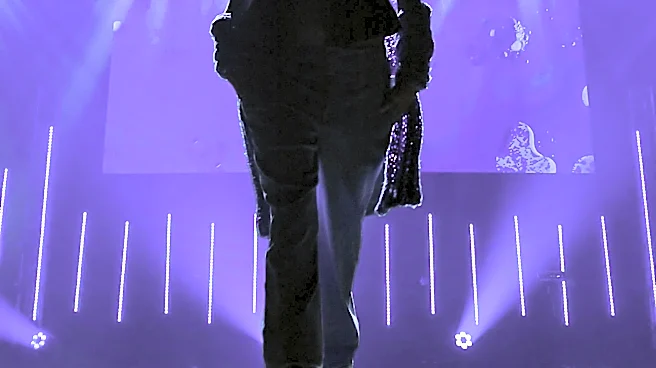
Director Jamie Lloyd's Broadway production of Shakespeare's 'Much Ado About Nothing' at the Winter Garden Theatre is a vibrant, unconventional take on the classic play. The production features a constant cascade of pink petals and incorporates pop music,
with Margaret (Mason Alexander Park) serving as a cabaret host singing hits like Taylor Dane's 'I feel the night explode' and All-4-One's 'I Swear.' Tom Hiddleston stars as Benedick, delivering a performance that is both charismatic and interactive with the audience. Hayley Atwell plays Beatrice. Lloyd's direction emphasizes an optimistic, big-hearted romp about love, often downplaying the play's more complex or problematic elements, such as the Claudio/Hero subplot. The set design is minimal, relying on the confetti and a giant inflatable heart to create the desired atmosphere.
Why It's Important?
This production represents a significant departure from traditional Shakespearean interpretations on Broadway, showcasing a trend towards more immersive, contemporary, and audience-engaging theatrical experiences. Jamie Lloyd's audacious approach, combining classic text with modern pop culture elements, aims to make Shakespeare accessible and appealing to a broader, potentially younger, audience. For the theater industry, it highlights the commercial viability of innovative adaptations that can draw in crowds, especially with a star like Tom Hiddleston. The emphasis on spectacle and audience interaction could influence future theatrical productions, encouraging more experimental staging and a blurring of lines between classic and contemporary performance styles. However, it also raises questions about the balance between artistic interpretation and fidelity to the original text, and how much a production can deviate while still retaining the essence of the source material.
Beyond the Headlines
The production's choice to downplay the problematic aspects of 'Much Ado About Nothing,' particularly the swift forgiveness of Claudio by Hero, reflects a broader cultural shift in how audiences and creators engage with historical texts. In an era increasingly sensitive to themes of consent, justice, and gender dynamics, traditional narratives can be challenging. Lloyd's approach of prioritizing a celebratory, love-focused romp might be seen as a way to navigate these complexities by sidestepping them, focusing instead on the more palatable aspects of the story. This raises a deeper discussion about whether classic works should be reinterpreted to fit modern sensibilities or if their original contexts and challenges should be confronted directly. The use of pink confetti and pop music also speaks to the commercialization of art, where aesthetic appeal and immediate gratification can sometimes overshadow deeper thematic exploration.