


What's Happening?
Treasury Secretary Scott Bessent has issued a warning that the Federal Reserve risks making a 'policy mistake' if it over-tightens monetary policy. Appearing on 'Face the Nation' on Sunday, November 22, Bessent attributed recent stock market selloffs
to both political factors, including investor concerns about a Democratic push to slow AI expansion, and the Federal Reserve's 'very hawkish remarks.' He highlighted a 'substantial tightening in financial conditions over the past few months' as a key reason for his concern. This marks Bessent's third such warning since November 13, where he previously cautioned against excessive rate hikes amidst an easing energy supply shock and described recent inflation data as 'noisy.' His comments came before a significant rebound in the S&P 500 on Monday, which gained 4.73%. Despite this, the iShares 20+ Year Treasury Bond ETF (TLT) saw only a minimal gain, suggesting bond investors still anticipate further rate hikes from the Fed.
Why It's Important?
Secretary Bessent's repeated warnings underscore a growing tension between the Treasury Department's perspective on economic conditions and the Federal Reserve's current hawkish stance. His concerns about over-tightening suggest a belief that the Fed's actions could unnecessarily stifle economic growth, particularly impacting sectors heavily reliant on future earnings and financing, such as artificial intelligence. If the Fed proceeds with aggressive rate hikes, it could increase borrowing costs across the economy, potentially leading to a slowdown in investment and consumer spending. This divergence in views from key economic policymakers could create uncertainty in financial markets. Furthermore, public pressure from the Treasury on the Fed carries risks; if investors perceive the Fed as succumbing to political influence, they might demand higher yields for long-term bonds, counteracting the administration's desire for lower rates and potentially complicating the Fed's efforts to manage inflation and employment independently.
What's Next?
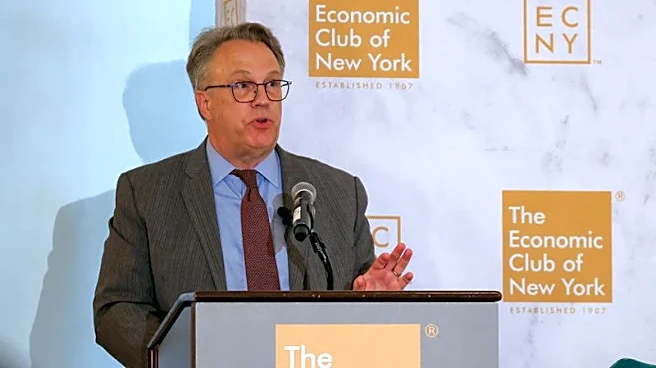
The Federal Reserve's next policy decision is scheduled for Wednesday, December 9, following its two-day meeting. Market participants will closely watch whether Fed officials, such as Governor Christopher Waller, continue to advocate for a half-point rate hike, or if New York Fed President John Williams maintains his stance on consecutive hikes. Key economic data releases, including October PCE inflation and the second estimate of third-quarter GDP on Wednesday, November 25, will likely influence the Fed's decision. A strong inflation reading could bolster arguments for further tightening, while softer data might support Bessent's view that inflation signals are inconsistent. The market has largely priced in a quarter-point hike for December, but a larger move or a commitment to successive hikes could significantly impact AI-heavy stocks like NVIDIA, Apple, and Microsoft, which are major components of the S&P 500.
Beyond the Headlines
The public discourse between the Treasury Secretary and the Federal Reserve highlights a fundamental aspect of U.S. economic governance: the delicate balance between fiscal policy (Treasury) and monetary policy (Fed). While both aim for economic stability and growth, their approaches and immediate priorities can differ. Bessent's intervention could be interpreted as an attempt to influence the Fed's independent decision-making, raising questions about the boundaries of such public commentary and its potential impact on market confidence in the Fed's autonomy. The long-term implications could involve a re-evaluation of how much public officials should comment on the Fed's policy decisions, especially when those comments could be perceived as political pressure. This dynamic is crucial for maintaining the credibility and effectiveness of both institutions in managing the nation's economy.