







What's Happening?
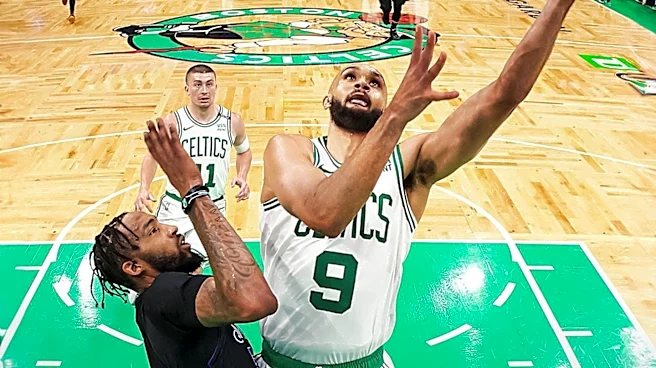
Derrick White, a player for the Boston Celtics, has recently signed a four-year contract extension valued at $118 million. This significant deal is being observed closely within the NBA as it establishes a new financial benchmark for players in similar
roles. The contract is particularly relevant for individuals like Josh Hart of the New York Knicks, who is currently eligible for an extension. Hart's representatives are expected to use White's contract as a comparable reference point during their negotiations, aiming for a substantial salary increase. The extension for White highlights the evolving market value for key role players in the league, moving beyond just superstar contracts to recognize the contributions of integral team members. This development underscores a trend where teams are willing to invest heavily in players who provide consistent performance and fit well within their system, even if they are not considered primary scoring options.
Why It's Important?
This contract extension for Derrick White carries significant implications for player valuations and salary negotiations across the NBA. By securing a $118 million deal, White's contract sets a new precedent for what teams are willing to pay for high-performing, non-superstar players. This benchmark directly impacts players like Josh Hart, who, despite not being a primary scorer, has proven indispensable to his team, the New York Knicks. Hart's agents can now leverage White's contract to argue for a higher salary, potentially pushing his annual earnings into the $25-30 million range. This trend could lead to an overall increase in player salaries for those in crucial supporting roles, affecting team salary caps and financial strategies. For franchises, it means a re-evaluation of their budget allocations, as retaining valuable role players will become more expensive. This shift could also influence draft strategies, placing a higher premium on developing versatile players who can contribute significantly without necessarily being top-tier offensive threats.
What's Next?
The immediate next step will likely involve Josh Hart's contract negotiations with the New York Knicks. With Derrick White's extension as a fresh comparable, Hart's representatives are expected to push for a deal in the range of $25-30 million annually, potentially totaling up to $132 million over four years, though the source suggests a more realistic starting point for discussions would be around $25-30 million per year. The Knicks will need to balance their financial constraints with the desire to retain a player who is deeply integrated into their team's project and has a strong relationship with star Jalen Brunson. This negotiation will be crucial for Hart, as at 31 years old, this next contract is likely his last opportunity for a major NBA payday. The outcome of these discussions could further solidify the new salary expectations for similar players across the league, influencing future contract talks for other valuable role players.
Beyond the Headlines
The contract extension for Derrick White, and its subsequent impact on players like Josh Hart, reflects a deeper evolution in NBA team building and player valuation. Beyond the immediate financial implications, this trend highlights a growing recognition of the importance of 'glue guys' and versatile role players who contribute significantly to team success without necessarily being the primary offensive engines. Teams are increasingly valuing players who excel in defense, rebounding, and playmaking, understanding that these contributions are critical for championship contention. This shift could lead to a more balanced distribution of wealth within teams, moving away from a sole focus on superstar salaries. Ethically, it validates the hard work and specialized skills of players who might not always grab headlines but are essential to a team's chemistry and performance. Culturally, it could foster a greater appreciation among fans for the diverse skill sets and roles that make up a successful basketball team, moving beyond individual scoring statistics to a more holistic view of player impact.