



What's Happening?
Fabri, a company founded by Steven Davis, Thomas Cole, and Pieter Coulier, is working to revitalize the U.S. metal casting industry by employing additive manufacturing, software, and vertical integration. The company's approach aims to eliminate many
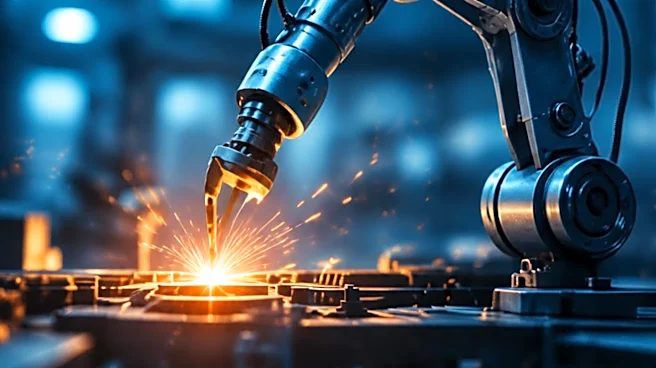
labor-intensive steps associated with traditional metal casting, a sector where over 70% of American facilities have closed since its peak in the 1950s. Fabri is currently producing parts for clients like Raytheon, Lockheed Martin, and Sikorsky Aircraft at its 16,000-square-foot plant in Billerica, Massachusetts. Their proprietary software, FoundryOS, designs patterns for parts from CAD files, which are then printed in resin. This process automates the creation of complex patterns and channels, significantly reducing the time and cost associated with traditional tooling. Fabri's method allows for rapid iteration on parts, with the ability to go from design to finished product in as little as a week, a stark contrast to the months required by conventional methods.
Why It's Important?
The revitalization of the U.S. metal casting industry by companies like Fabri is crucial for national security and economic resilience. Metal casting is fundamental for critical sectors such as aerospace, defense, medical devices, and power generation. The U.S. reliance on foreign countries like China and India for these essential components poses significant supply chain risks. Fabri's innovative approach, which addresses labor shortages and accelerates production, can reduce this dependency, strengthening domestic manufacturing capabilities. By making metal casting faster and more efficient, the company contributes to the onshoring of production, creating jobs, and fostering technological leadership in advanced manufacturing. The ability to quickly produce complex parts for defense and aerospace applications is particularly vital, ensuring that critical national programs are not delayed by lengthy lead times or external supply chain vulnerabilities.
What's Next?
Fabri plans to significantly expand its capacity by building a larger facility in 2027 to produce bigger parts at higher volumes as customer programs move into full production. The company is also moving through qualification processes to manufacture parts for the most critical aerospace and defense applications. In early 2027, Fabri intends to begin casting nickel superalloys, which are crucial for turbine blades and currently face four-year wait times. This expansion and material diversification will further solidify its role in critical supply chains. The success of Fabri's model could encourage other companies to adopt similar advanced manufacturing techniques, potentially leading to a broader resurgence of the U.S. metal casting industry and a reduction in reliance on overseas production.
Beyond the Headlines
Fabri's success in streamlining metal casting through automation and software highlights a broader trend in U.S. manufacturing: the integration of digital technologies to overcome traditional industrial challenges. This development has profound implications for the future of skilled labor and industrial education. As automation reduces the need for manual, labor-intensive tasks, there will be an increased demand for engineers and technicians proficient in additive manufacturing, software development, and robotics. This shift necessitates a re-evaluation of educational curricula to prepare the workforce for these advanced roles. Furthermore, the ability to rapidly prototype and produce complex parts domestically could foster a new era of innovation, allowing for quicker development cycles and more agile responses to market demands and national security needs. The 'encoding' of domain knowledge into software, as Fabri does with FoundryOS, also represents a long-term strategy for preserving and advancing industrial expertise, mitigating the impact of an aging workforce.