



What's Happening?
The Qatar Chamber recently participated in the fifth Arab-Brazilian Economic Forum in São Paulo, Brazil, where Mohamed bin Ahmed Al-Obaidli, a Board Member and Chairman of the Food Security and Environment Committee and the Technology and Innovation Committee,
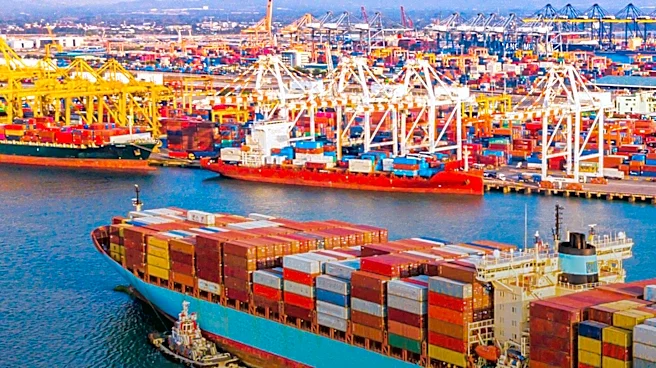
emphasized Qatar's strong infrastructure positioning it as a reliable global logistics hub. Al-Obaidli spoke during a session focused on 'Food Security, Agribusiness and Resilience of Fertiliser Supplies,' highlighting the strategic partnership between Arab nations and Brazil. He noted Brazil's leadership in agricultural and food products and Qatar's leadership in energy and fertilizer production, seeing this as a foundation for long-term investments and cooperation. He also underscored Qatar's advancements in strengthening food security through increased local production, diversified import sources, robust strategic reserves, and expanding foreign investments in national food security projects.
Why It's Important?
Qatar's assertion of its role as a global logistics hub, particularly in the context of food security and agribusiness, is significant for international trade and supply chain resilience. By leveraging its advanced transportation, storage, and distribution networks, Qatar aims to enhance its economic influence and diversify its economy beyond energy. This initiative could lead to increased foreign investment and collaboration, particularly with agricultural powerhouses like Brazil, fostering more stable and efficient global supply chains for essential goods like food and fertilizers. For the U.S. and other global partners, a robust logistics hub in Qatar could offer new avenues for trade, reduce transit times, and improve the reliability of supply routes, especially for goods moving between the Americas, Europe, and Asia. The focus on technology and artificial intelligence in agriculture also signals a forward-thinking approach to addressing global food challenges, which could inspire similar innovations in other regions.
What's Next?
Qatar is expected to continue pursuing strategic partnerships and investments to solidify its position as a global logistics and food security hub. The emphasis on leveraging technology and artificial intelligence to develop agriculture and enhance productivity suggests future collaborations in agtech solutions. This could involve joint ventures, technology transfers, and research initiatives with countries like Brazil. The ongoing efforts to strengthen food security through local production and strategic reserves indicate a sustained commitment to national resilience, which may lead to further investments in agricultural infrastructure and innovative farming techniques. The discussions at the Arab-Brazilian Economic Forum are likely to translate into concrete agreements and projects aimed at fostering economic, trade, and investment cooperation, particularly in food production, fertilizers, processing, cold-chain logistics, and agricultural technology.
Beyond the Headlines
Qatar's strategic move to become a global logistics hub, particularly in food and fertilizer supply chains, has deeper geopolitical and economic implications. In an era marked by increasing supply chain disruptions and concerns over food security, a reliable and efficient hub like Qatar can play a crucial role in stabilizing global markets. This initiative not only diversifies Qatar's economy but also enhances its soft power and influence on the international stage. By positioning itself as a critical node in global trade, Qatar can strengthen its diplomatic ties and foster greater economic interdependence. The focus on technology and AI in agriculture also highlights a broader trend towards sustainable and efficient resource management, which is vital for addressing climate change and population growth. This strategic vision could serve as a model for other nations seeking to enhance their economic resilience and contribute to global stability.