






What's Happening?
A former nuclear power plant site in Lemóniz, Spain, which was never activated despite significant construction, is set to be repurposed into a large-scale sole fish farm. The Basque Government has awarded the site to Sea Eight, a Valencian investment
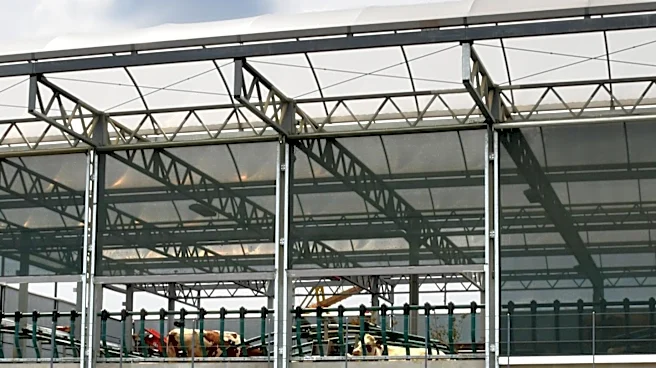
group and the world's largest land-based producer of Senegalese sole. This decision came despite a larger financial offer from a Norwegian firm, Haugland, which intended to demolish the existing structures. Sea Eight's proposal, Aquacría Basordas, plans to utilize the unfinished reactor buildings and existing seawater intakes for its recirculating aquaculture systems (RAS). The project, estimated at €170 million (approximately $193 million) in combined public and private funding, aims to produce up to 3,000 metric tons of sole annually. Construction on the first phase is slated for 2027, with the first fish reared in 2029 and initial sales projected for 2031. The Lemóniz plant, initiated in 1972, was halted due to a strong anti-nuclear movement, attacks by the ETA separatist group, and a national moratorium on new nuclear plants in 1984.
Why It's Important?
This development in Spain offers a unique perspective on the future of 'stranded' nuclear assets globally, including in the United States. The decision to convert a nearly complete nuclear plant into an aquaculture facility, prioritizing the reuse of existing infrastructure over demolition, suggests a novel approach to managing costly, unutilized industrial sites. For the U.S., where discussions about resurrecting or repurposing nuclear plants like Palisades in Michigan and Three Mile Island are ongoing, the Lemóniz case could serve as an unconventional precedent. It highlights that the value of such sites might extend beyond traditional energy or industrial uses, potentially opening avenues for diverse economic activities. The project also underscores the growing importance of sustainable aquaculture and the potential for innovative solutions to food production challenges, leveraging existing infrastructure to reduce environmental impact and development costs. The economic implications include job creation and significant investment in a new industry, demonstrating how abandoned large-scale projects can be revitalized for modern economic needs.
What's Next?
The Aquacría Basordas project faces several critical steps before becoming fully operational. While a preliminary understanding exists, a formal agreement between Sea Eight and the Basque Government has yet to be signed, and the exact financial contributions from each party are still being finalized. Construction on phase one is scheduled to commence in 2027, followed by the rearing of the first sole in 2029, and the first market sales in 2031. The project also needs to secure necessary permits and environmental assessments. Opposition from groups like Greenpeace Spain, which argues for the site's restoration and raises concerns about the environmental impact of carnivorous fish farming, could lead to further scrutiny and potential delays. Local government bodies in the Uribe Kosta district have also called for public consultation, indicating ongoing community engagement will be crucial. The long timeline for completion suggests ample opportunity for adjustments or challenges to arise before the project is fully realized.
Beyond the Headlines
The repurposing of the Lemóniz nuclear plant into a fish farm delves into deeper implications regarding industrial legacy, environmental stewardship, and economic innovation. Ethically, the decision to reuse existing infrastructure rather than demolish it, despite a higher bid for demolition, reflects a potential shift towards valuing sustainability and adaptive reuse in large-scale industrial projects. It challenges the conventional view of 'waste' or 'abandoned' sites, suggesting that their inherent structural and locational advantages, such as access to seawater, can be leveraged for entirely different purposes. This case also highlights the complex interplay between economic development, environmental concerns, and community interests, as evidenced by the opposition from environmental groups and local councils. The long-term shift could see more creative solutions for former industrial sites, moving beyond traditional redevelopment models to embrace novel, environmentally conscious, and economically viable ventures. The U.S. experience with the Satsop Business Park, a former nuclear site converted into an office park, demonstrates a similar, albeit less ambitious, trend of adaptive reuse, underscoring a global movement towards reimagining industrial ruins.