







What's Happening?
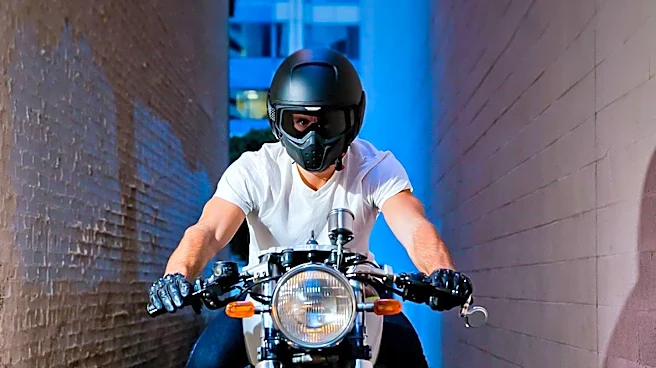
Dan Aykroyd recently shared an anecdote about a wild incident involving himself and Bill Murray during the filming of 'Ghostbusters II' in 1989. According to Aykroyd, one night while shooting, they 'appropriated' two fully equipped police motorcycles
from the movie's motor pool. The duo then spent approximately an hour chasing each other around a closed Central Park, utilizing the motorcycles' full lights and sirens. Aykroyd noted that there were 'no consequences' for their actions, humorously attributing this to their status as 'Ghostbusters.' This event occurred during the production of the sequel to the highly successful 1984 film, which saw Aykroyd and Murray reprise their roles as Ray Stantz and Peter Venkman, respectively.
Why It's Important?
This story offers a rare glimpse into the behind-the-scenes camaraderie and playful antics of two iconic comedic actors during the production of a major Hollywood film. It highlights the unique environment of a film set, where the lines between reality and fiction can sometimes blur, leading to spontaneous and unauthorized activities. The lack of consequences for their actions, as stated by Aykroyd, could be attributed to their star power and the relaxed atmosphere often found on film sets, especially for established actors. This incident contributes to the legendary status of both actors and the 'Ghostbusters' franchise, reinforcing the perception of their larger-than-life personalities and their ability to create memorable moments both on and off screen. It also provides insight into the creative freedom and occasional mischief that can occur during demanding film schedules.
What's Next?
While this specific event is a past occurrence, it contributes to the ongoing legacy and public perception of Bill Murray and Dan Aykroyd, particularly within the 'Ghostbusters' universe. Such anecdotes often resurface during promotional tours for new installments of the franchise or in retrospectives, further endearing the actors to their fanbase. For the actors themselves, these stories become part of their personal and professional narratives, often shared in interviews or memoirs. For the film industry, it serves as a lighthearted reminder of the human element in filmmaking, where personal interactions and spontaneous moments can become as memorable as the on-screen performances. It also subtly underscores the need for production teams to manage resources and ensure safety, even amidst the creative chaos of a film set.
Beyond the Headlines
This incident, while seemingly minor, reflects a broader cultural fascination with the off-screen lives of celebrities and the perceived freedom that comes with fame. The idea of 'no consequences' for such an act, even if exaggerated for comedic effect, speaks to the unique privileges sometimes afforded to public figures. It also touches upon the concept of 'method acting' or deep immersion in a role, where the actors, embodying their 'Ghostbusters' personas, felt empowered to engage in playful rebellion. This kind of story helps to humanize celebrities, making them relatable while simultaneously reinforcing their larger-than-life status. It also highlights the enduring appeal of the 'Ghostbusters' franchise, where the actors' real-life chemistry and antics often mirror the playful spirit of the films.