





What's Happening?
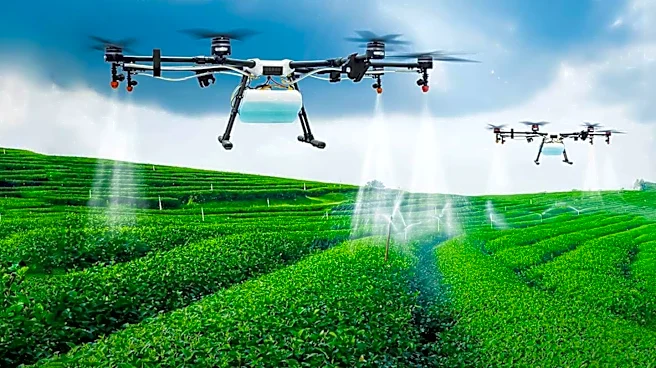
Eric Hansotia, Chairman and CEO of AGCO Corp., has provided insights into the current landscape of the agricultural industry, focusing on the demand for technology among farmers. He highlighted that farmers are actively seeking technological solutions
to address various challenges. The discussion covered several key areas impacting the agricultural sector, including ongoing trade uncertainty, pressures faced by farmers, the role of precision agriculture, the integration of artificial intelligence (AI), and the effects of tariffs. Hansotia emphasized how technology can play a crucial role in reducing operational costs and enhancing efficiency within farming practices. His remarks underscore a broader trend in agriculture towards adopting advanced tools and methods to navigate economic and environmental complexities.
Why It's Important?
The insights from AGCO CEO Eric Hansotia are significant for the U.S. agricultural industry and related technology sectors. The emphasis on farmers' demand for technology signals a growing market for innovation in precision agriculture, AI-driven solutions, and other efficiency-boosting tools. This trend can lead to increased investment in agricultural technology research and development, potentially creating new jobs and fostering economic growth in rural areas. For farmers, adopting these technologies could mean improved yields, reduced input costs, and greater resilience against market fluctuations and climate challenges. However, it also highlights potential disparities, as access to and affordability of advanced technology might become a barrier for smaller farms. The discussion on trade uncertainty and tariffs underscores the vulnerability of the agricultural sector to global economic policies, impacting both producers and consumers.
What's Next?
Following the discussions by AGCO CEO Eric Hansotia, the agricultural technology sector is likely to see continued innovation and investment, particularly in precision agriculture and AI applications. Companies in this space will likely focus on developing more accessible and cost-effective solutions to meet the growing demand from farmers. Policy discussions around trade uncertainty and tariffs will remain critical, as their outcomes directly influence the economic viability of agricultural operations. Farmers are expected to increasingly evaluate and adopt new technologies to enhance productivity and manage costs, potentially leading to a more technologically advanced and efficient agricultural landscape in the U.S. Furthermore, educational initiatives and support programs may become necessary to ensure that all farmers, regardless of scale, can benefit from these advancements.
Beyond the Headlines
The push for technology in agriculture, as discussed by AGCO CEO Eric Hansotia, extends beyond immediate cost savings and efficiency gains. It touches upon the long-term sustainability and competitiveness of the U.S. agricultural sector. The integration of AI and precision agriculture could lead to more data-driven farming, optimizing resource use and potentially reducing environmental impact. This shift could redefine traditional farming practices, moving towards a more technologically sophisticated and environmentally conscious approach. However, it also raises questions about data privacy, the digital divide in rural communities, and the potential for increased consolidation in the agricultural industry as larger, more technologically advanced operations gain an advantage. The ethical implications of AI in food production and the need for robust cybersecurity measures in connected farm equipment are also emerging considerations.