





What's Happening?
Insurance broker WTW, in collaboration with Cullen Hendrix, a senior fellow at the Peterson Institute for International Economics (PIIE), has issued a warning regarding the increasing supply concentration risk within South America's Lithium Triangle.
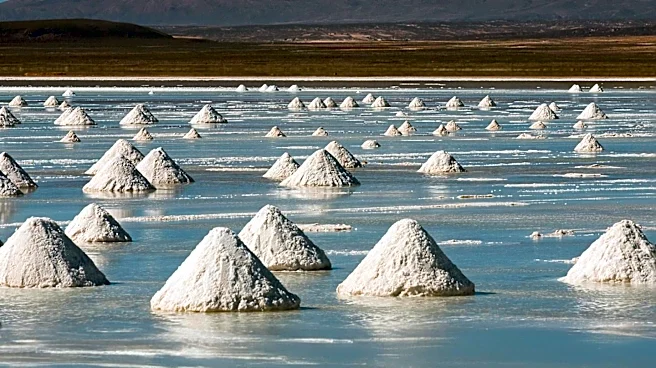
This region, encompassing northern Chile, north-west Argentina, and south-west Bolivia, holds approximately 45% of the world's identified lithium resources. Given lithium's critical role in electrification, batteries, and clean energy technologies, any disruption in this area, even if localized, could have significant and far-reaching implications for corporations, lenders, and insurers globally. The report emphasizes that corporate exposure to the lithium market is deeply embedded across various portfolios, counterparties, and supply chains, often in ways that are not immediately apparent, meaning organizations could be affected even without direct involvement in lithium production.
Why It's Important?
The growing supply concentration risk in the Lithium Triangle is critically important for U.S. industries and the broader economy, particularly those involved in electric vehicles, renewable energy, and technology. A disruption in lithium supply could severely impact the production of batteries, leading to increased costs, delays in manufacturing, and potential setbacks in the transition to clean energy. This could affect the competitiveness of U.S. companies reliant on lithium, from automotive manufacturers to consumer electronics producers. The report highlights that the primary driver of loss in such scenarios is not necessarily physical damage but systemic exposure across markets and supply chains due to concentration risk. This necessitates a re-evaluation of risk management strategies for U.S. businesses, urging them to look beyond traditional insurance coverage and consider broader resilience frameworks to identify and mitigate potential vulnerabilities in their supply chains.
What's Next?
WTW and PIIE recommend that companies with exposure to the lithium market conduct stress tests to assess their protection against potential supply chain disruptions. This includes evaluating whether insurance coverage extends beyond physical damage triggers and checking policies for ambiguities or exclusions. Companies are advised to identify early indicators of disruption, assess high concentration risks or blind spots in their supply chains, and stress-test alternative routes or suppliers. For banks and traders, the focus should be on assessing the impact of political actions, currency restrictions, or liquidity stress on borrowers' ability to repay. Strong risk management practices are also highlighted as crucial for project developers to attract capital and insurance capacity. These recommendations suggest a proactive shift towards comprehensive risk assessment and resilience building within the U.S. and global lithium supply chain.
Beyond the Headlines
The report's emphasis on non-physical damage as the primary driver of loss in supply chain disruptions reveals a deeper, less obvious implication: the increasing vulnerability of modern economies to geopolitical, environmental, and social factors. The 'Lithium Triangle' scenario underscores how issues like environmental stress, indigenous mobilization, fiscal politics, and territorial disputes can escalate local incidents into global supply chain crises. This highlights the ethical and strategic imperative for U.S. companies and policymakers to consider the broader socio-political landscape of resource extraction. Long-term shifts could involve greater investment in diversified sourcing, advanced recycling technologies, and diplomatic efforts to stabilize critical resource regions, moving beyond purely economic considerations to embrace a more holistic approach to supply chain security and sustainability.