


What's Happening?
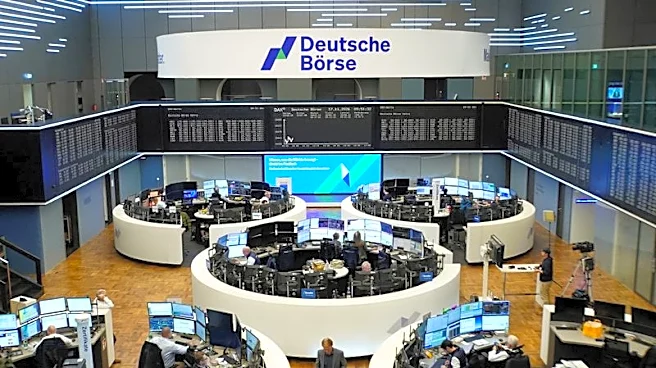
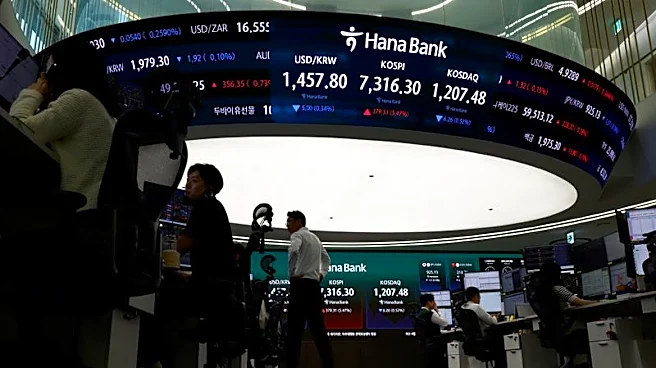
Tej Johar of Trium Capital is betting that the significant premium on SK Hynix's U.S.-listed shares, which currently stands at about 48% compared to its shares traded in Seoul and Frankfurt, will shrink. Johar presented this investment thesis at the Sohn
London investment conference, highlighting an "$8 billion alpha opportunity." He noted that the premium for American Depositary Receipts (ADRs) has widened from 13% to approximately 48% since the South Korean chipmaker listed on Nasdaq in July. Johar attributes this divergence to the strong U.S. investor appetite for exposure to artificial intelligence (AI), suggesting that investors elsewhere have not paid the same markup. His strategy involves buying the cheaper securities and shorting the more expensive U.S. shares, a relative-value arbitrage trade.
Why It's Important?
This investment strategy highlights a potential market inefficiency driven by regional investor sentiment, particularly the enthusiasm for AI in the U.S. The significant premium on SK Hynix's U.S. shares suggests that American investors are willing to pay more for AI-related exposure, which could distort market valuations. If Johar's bet proves correct, it could lead to a re-evaluation of how AI-driven demand impacts stock prices across different markets. This situation also raises questions about fiduciary duty for institutional investors, as Johar argues that paying a 48% premium for the same share is difficult to justify to clients. A narrowing of this premium could impact U.S. investors holding SK Hynix ADRs and potentially influence investment strategies in other AI-related stocks.
What's Next?
The success of Trium Capital's bet hinges on the narrowing of the price gap between SK Hynix's U.S. and international listings. Johar suggests that large institutional shareholders might move into the cheaper securities, driven by a fiduciary duty to seek better value, or that a shift in sentiment around the 'shaky' AI trade could act as a catalyst. Historically, average ADR premiums have been near zero, and similar gaps have closed quickly. The key uncertainty remains whether these investors will actually make the switch. If the premium does shrink, it could trigger similar arbitrage opportunities in other globally traded stocks with significant regional price discrepancies, particularly those influenced by sector-specific investor enthusiasm.
Beyond the Headlines
This scenario underscores the complex interplay between global financial markets, investor psychology, and technological trends like AI. The existence of such a substantial premium for U.S.-listed shares of a foreign company reflects the powerful influence of narrative-driven investing, where the perceived value of exposure to a hot sector like AI can override traditional valuation metrics. It also highlights the role of arbitrageurs in correcting market inefficiencies. Beyond the immediate financial implications, this situation could prompt a broader discussion among institutional investors about their due diligence processes and the potential risks associated with regional market exuberance, especially in rapidly evolving technological sectors. The outcome of this trade could serve as a case study for the impact of AI enthusiasm on global equity markets.