






What's Happening?
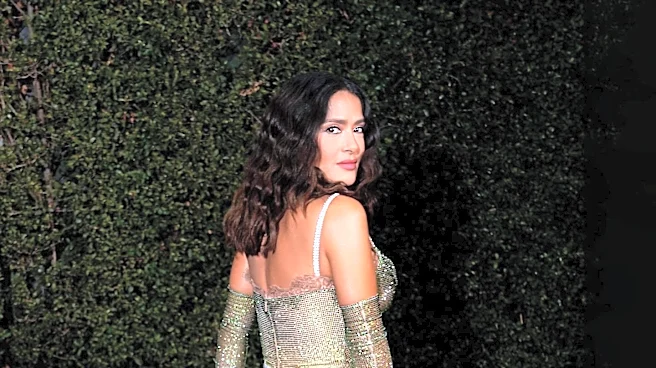
Salma Hayek revealed that she faced significant studio pressure to be replaced by Cameron Diaz for her breakthrough role as Carolina in the 1995 film 'Desperado.' Despite director Robert Rodriguez initially casting Hayek, the studio pushed back, suggesting
Diaz for the role. Hayek recounted that the studio cited Diaz's last name and her then-rising popularity, following her breakout performance in 'The Mask,' as reasons she 'can be Mexican.' This forced Hayek to re-audition for a role she had already secured. The incident highlights a historical trend in Hollywood where studios would justify 'whitewashing' roles by claiming audiences wouldn't seek out Latin actors, even when the director, like Rodriguez, had a relevant background. Hayek's background in Mexican soap operas also made her seem 'replaceable' in the eyes of Sony.
Why It's Important?
This revelation underscores the historical challenges and systemic biases faced by Latina actresses in Hollywood, particularly concerning representation and casting decisions. The studio's rationale for considering Cameron Diaz—her last name and popularity—illustrates a superficial understanding of cultural identity and a willingness to prioritize marketability over authentic casting. This practice of 'whitewashing' not only limits opportunities for actors of color but also perpetuates inaccurate and stereotypical portrayals on screen. For U.S. audiences, it means a less diverse and less authentic cinematic landscape, potentially reinforcing harmful cultural narratives. The incident also sheds light on the power dynamics within film production, where studio executives can override a director's casting choices, impacting careers and artistic integrity. Hayek's eventual success in the role, and her subsequent collaborations with Rodriguez, demonstrate her resilience and talent in overcoming such industry hurdles.
What's Next?
While this specific event occurred in the past, its implications continue to resonate within ongoing discussions about diversity and inclusion in Hollywood. The industry is currently under increased scrutiny to address historical inequities and promote more authentic representation. This includes initiatives to support and cast actors from underrepresented communities and to ensure that creative control is not unduly influenced by discriminatory biases. Future developments may involve continued advocacy from organizations pushing for greater diversity, as well as studios implementing more rigorous policies to prevent 'whitewashing' and ensure equitable casting practices. The story serves as a reminder for current and future filmmakers and studio executives to critically examine their casting processes and challenge preconceived notions about audience preferences and actor suitability.
Beyond the Headlines
The 'Desperado' casting controversy touches upon deeper ethical and cultural dimensions within the entertainment industry. It highlights the long-standing issue of cultural appropriation, where studios attempt to capitalize on ethnic identities without genuinely engaging with or representing those cultures. The idea that a non-Latina actress could be deemed 'Mexican' simply due to a surname, or that a Latina actress's background in foreign productions made her 'replaceable,' reveals a problematic mindset that devalues authentic cultural experience. This practice not only impacts individual careers but also contributes to a broader societal narrative where certain identities are commodified or erased. The eventual crossing of paths between Hayek and Diaz in the 'Shrek' and 'Puss in Boots' franchises, where Hayek voiced Kitty Softpaws and Diaz voiced Princess Fiona, offers an interesting, albeit coincidental, full circle moment, showcasing both actresses' enduring careers despite the industry's past biases.